
PART 3: CONCLUSION AND NEXT STEPS


“The ideas of the ruling class are in every epoch the ruling ideas, i.e. the class which is the ruling material force of society, is at the same time its ruling intellectual force. The class which has the means of material production at its disposal, has control at the same time over the means of mental production, so that thereby, generally speaking, the ideas of those who lack the means of mental production are subject to it. The ruling ideas are nothing more than the ideal expression of the dominant material relationships, the dominant material relationships grasped as ideas.”
-Karl Marx, The German Ideology (1846)
Apply to Join 21CS: If you’re a DSA member, and interested in joining 21CS, be sure to apply here. For our series on "DSA Foreign Policy in Congress… and in a Presidential Campaign," you can also read Part 1 (Palestine) here and Part 2 (NATO and U.S. Militarism) here.
General Lessons and How to Course-Correct
The problems we are facing today are both individual problems of weakness and also structural problems of capitalist capture. History is very clear: capitalism is capable of co-opting, absorbing, and redirecting quasi-socialist energies in ways that neutralize budding movements. Sometimes it’s through picking off individuals, sometimes it’s by offering minor (momentum-killing) concessions, and sometimes it’s through more direct suppression. If we want to be students of history, rather than a bunch of dunces who mindlessly fall for the most obvious traps, then we need to see very clearly the landscape that lies ahead of DSA right now, and we need to be self-critical as an organization. We also need to be careful in who we select for leadership, knowing that a bad leader can mislead and destroy a socialist project.
The most chilling examples of the co-optation of socialist energy were seen in the lead-up to the fascist movements in Italy, Germany, and Austria. This was thoroughly documented in R. Palme Dutt’s brilliant book Fascism and Social Revolution (which our comrades in the Red Star caucus have written about here), where the author discusses the decline of industrial productive workers, combined with an increase in certain “non-productive occupations,” giving rise to a “new middle class” (and also “rentier class”) that becomes a breeding-ground for fascism. As we have written about previously, these groups are supported by finance capital and seek, above all, international exploitation (hence the jingoism of late capitalist and fascist countries, combined with the tolerance of this type of foreign policy by “social democrats”). In addition to supplying the ingredients for a fascist movement (similar to today’s emotion-driven MAGA movement of resentment politics), however, this type of development also brings a corresponding growth in various “reformers to capitalism” who likewise seek — above all else — to stop any movement towards socialism or communism, and provide a sort of release valve to reduce the pressure for larger changes. This is why we need to be especially mindful of false prophets and diversionary tactics today.

Looking back at historical examples, it’s remarkable how candid liberal and social democrat reformers were about their role in neutralizing — through whatever means — left-wing movements. Shortly after Marx’s death, Otto von Bismarck was very candid in a Reichstag speech (1884), saying that his repressive anti-socialist laws needed to be paired with some minor economic reforms so that the socialist base of “dissatisfied classes” didn’t reach a breaking point where the government would “lose control over the masses.” After Rosa Luxemburg and Karl Liebknecht were murdered in 1919 by right-wing paramilitary groups (Freikorps), Friedrich Ebert from the quasi-left German Social Democratic Party (SPD) had a telephone conversation with General Wilhelm Groener where the two (in the words of General Groener) “concluded an alliance to fight Bolshevism and Sovietism and restore law and order” (we know how that ended). Keynes wrote in 1925 (“Am I a Liberal?”) that the Liberal Party should become the vehicle for offering reforms within capitalism to stabilize it, and offer an “actual alternative to Marx's communism.” These are just a handful of examples, revealing a rather clever consciousness that seeks to use jiu jitsu against left movements rather than blunt opposition. We need to be constantly mindful of these tactics, because they are being used against us right now, in real time. Nevertheless, some of our comrades within DSA are dangerously close to falling for these same exact traps, dazzled by the potential of winning some kind of “power” as junior partners to the capitalist political formations. Although concessions might be reflections of our growing power, we always need to remember that this is a tactical move for certain classes to maintain power, and they would love nothing more than for us to be dazzled by the most minor concessions.
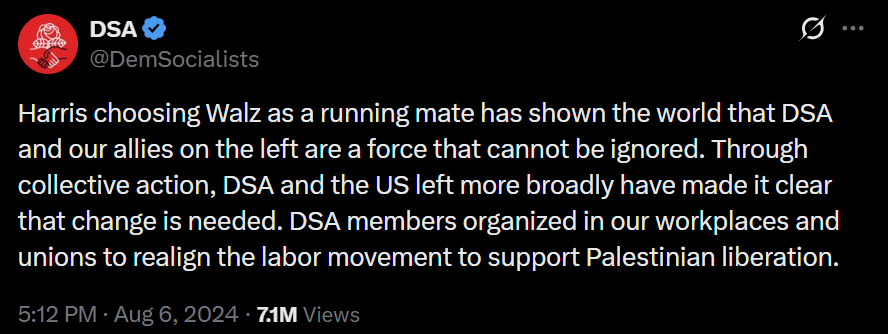
Antonio Gramsci wrote a bit about exactly this phenomenon. Seeing first-hand the weakness of “social democrat” leadership in Italy, and how it effectively neutralized more serious socialist energy (paving the way for fascism), Gramsci observed something that he called transformismo (co-optation). It first proceeded through what he called “molecular” transformism, where individual leaders (like Rep. Ocasio-Cortez) were picked off and “incorporated one by one into the conservative-moderate ‘political class.’” Following that, a mass of people “called socialist but in fact simply democratic” followed their lead and “crossed over to the moderate camp.” This type of bait-and-switch became possible when the public became so “nauseated” by the existing political class that they “would have sold themselves to the devil in order to escape the old parties that were putrefied down to the marrow of their bones.” Rather than moving forward towards socialism (something that may have been possible in Italy, if not for the transformism of left movements), this was a sort of political jiu jitsu that redirected the energy back into capitalism. Sound familiar?
Marx, Engels, Lenin, and many others wrote extensively about the pitfalls of opportunism and reformism. This is (or should be) well-known within DSA circles and should be a part of a basic political education for all of our members, including especially the newest members that have entered into the organization. Inoculation is very necessary, and we need to leave behind the pseudo-intellectuals who are constantly (and very publicly) flabbergasted by the very necessary critique of opportunism. The Democratic Party is not just a “ballot line,” it is also a well-oiled machine that has spent the past century converting “socialist” and “progressive” movements into a more compatible and non-threatening left. This is, more or less, how we ended up with the New Deal, a “social safety net” that has been playing defense for nearly a century, and a Cold War (with organized labor’s leadership pushing for worldwide anti-Communism) instead of a larger move to the left. The past century is a cautionary tale about what happens when certain classes are left in control. When the (deeply unpopular) Democratic Party is weak, as it is right now, we have a choice to either go in for the metaphorical kill shot or to rehabilitate this putrefied party of genocide. DSA right now stands (as they say) at a crossroads.
Mayor Zohran Mamdani says that “we’re not running away from the Democratic Party,” but rather “going back to what the party used to be” under the New Deal.
So how do we break out of this pattern that has destroyed so many left movements before us? For one, we need our own independent political program, which we unapologetically push for. We have grown as much as we have precisely because we are opposed to the Democrats. Notwithstanding the efforts of national DSA leadership, however, it has been very damaging to see various DSA-backed officials reneging or distancing themselves from various aspects of the DSA platform, in favor of traditional Democratic Party positioning. Unfortunately, Zohran Mamdani set the tone for this through his pro-NYPD policies, and although he still has time to course-correct (he has only been in office for a few months) by creating a new non-police unit to take over various of the NYPD’s functions, he has so far been very clear in his desire to distance himself from DSA on the issue and maintain a massive police presence (which, to date, still includes the “anti-terrorism” SRG unit that he had promised to disband due to its history of repression against the left). Following his lead, and sensing that she could move closer to the Democratic Party’s default pro-police position without backlash, Rep. Ocasio-Cortez has likewise distanced herself from the George Floyd movement, dismissively portraying its abolitionist demands to shrink the police force (“woke 1 was crazy”).34 More broadly, DSA candidates across the country have been grilled by “journalists” (mostly high-paid elitists from outlets owned by billionaires) about where they differ from DSA’s policy platform. Many DSA candidates have responded to these questions badly, sensing that they could just throw parts of the platform under the bus as individuals.35 For purposes of this analysis, we are most concerned by DSA candidates distancing themselves from the platform positions regarding anti-imperialism, where the opportunist tendencies are very high for the basic reason that the victims of imperialism typically don’t get to vote in our elections. If your “mass politics” only extends to the working class living within the current U.S. borders — or, even more narrowly, to the registered voters flagged in your MiniVAN mobile canvassing app — then you’re already lost as a socialist. We need to do better.
Notwithstanding the negative examples, there are also some people within our organization who see the issue clearly. Oliver Larkin, for instance, has gotten this issue exactly right:
If there is a difference of opinion on any piece of the platform, for instance, it's not my prerogative to try to separate myself and just enjoy the benefits of the endorsement and the mobilization and the chapter capacity that's being devoted, but then run away from the platform when it feels politically convenient. I'm a member of this organization, and I have been for over half a decade, and I feel a degree of responsibility to advocate for the positions of the organization that is growing and building such a strong and durable left flank in our politics. And if there is a difference of opinion, that can be metered out and discussed in the deliberative and democratic process of our chapter, general body meetings, or in the DSA national convention. I think there's a form and a process to registering your disagreement....
One problem . . . in the United States political system . . . [is] we have a system of the personal political entrepreneur, of someone like Graham Platner . . . or John Fetterman before him.... We need to get to a program that people can actually count on.... There's no real project that the American people can look to and say, “That's a Democrat, and I know what they believe because they're a Democrat.” It's a real mixed bag. And I think one of the advantages of DSA and of developing a platform, even if it might be challenging for some . . . I think there's a strong benefit in having some grounded principles and I think that should extend to every member of the organization, including elected officials, to have a responsibility to stand by that and to explain it to the people.
It’s good that Oliver Larkin has been carrying this message forward, because it is so fundamental to socialist organizing. In fact, this comes directly from Marx and Engels themselves. In an 1850 address to the Communist League, Marx spoke about an attempt by liberals to “ensnare the workers in a party organization in which general social-democratic phrases prevail while their particular interests are kept hidden.” Such an alliance would be one where the socialists’ demands would be throttled “for the sake of preserving the peace,” and “such a unity would be to their [i.e., the liberals’] advantage alone and to the complete disadvantage of the proletariat,” who would be “reduced once more to a mere appendage of official bourgeois democracy.” Marx clearly rejected this kind of subservient “alliance.” Likewise, in 1865, Engels wrote The Prussian Military Question and the German Workers’ Party, and made the following argument:
It goes without saying that in all these cases the workers’ party should not just act as the tail of the bourgeoisie, but as an independent party quite separate from them. It should remind the bourgeoisie on each occasion that the workers’ class interests are directly opposite of the capitalists’, and that the workers are aware of that. It should hold fast to, and build, its own organization vis-a-vis the bourgeoisie’s party organization, and only negotiate with the latter as one power with another. In that way, it would gain a position of respect that would make the individual workers clear about their class interests, and be ready to act in the next revolutionary storm—and these storms are now as regularly recurrent as trade crises and equinoctial storms.
Similarly, in a 1871 speech to the London Conference of the International Working Men's Association, Marx declared that “our politics must be working-class politics” and that “the workers’ party must never be the tagtail of any bourgeois party; it must be independent and have its goal and its own policy.” They were well aware of the dangers of socialists, communists, and the working class lining up behind the lead of bourgeois reformers.36

Being independent means actively resisting the weak and deeply unpopular Democratic party leadership, rather than falling in line behind people like Rep. Hakeem Jeffries. They are very vulnerable and weak right now, and they benefit tremendously from the energized insurgent movement falling in line behind their mis-leadership. Pseudo-intellectuals and smug strategists within our ranks often underestimate just how much these goblins benefit from friendly DSA faces supporting them. Democratic leadership is on life-support, and we don’t need to donate our internal organs to revive them. These vampires need our fresh blood in order to continue their reign of terror. It’s not lost on us that people like Rep. Jeffries are not even the “lesser evil,” so much as a “reset” button for evil, and that our ability to openly oppose them is our source of power (rather than our ability to deliver “wins” through them, to the extent they might allow it). Further empowering them leads to bad results, especially on international issues where they are constantly escalating in the wrong direction. One need only look at how Rep. Jeffries has selected some of the most bloodthirsty, right-wing Democrats to serve in foreign policy positions, stacking the House Committee on Foreign Affairs with Reps. Gregory Meeks (NY), Jared Moskowitz (FL), George Latimer (NY), Debbie Wasserman Schultz (FL), and Wesley Bell (MO).37 Likewise, the House Armed Services Committee is led by right-wing Democrat Rep. Adam Smith (WI), where it regularly pushes to appear more pro-military than the Trump administration. These individuals — in a perfect reflection of Rep. Jeffries himself — reliably push the Trump administration (already very bad) to go even further in his destructive foreign policy campaigns, to further entrench NATO military engagements in Europe (e.g., Rep. Smith amending the NDAA to purportedly restrict troop withdrawals from Europe), to act with further belligerence towards Iran and Yemen (see below), and to take further aggressive actions against socialist governments abroad (e.g., Rep. Meeks pushing the Trump administration to further arm the Taiwanese separatists take a more aggressive posture towards North Korea).38 Empowering this (e.g., by voting for Hakeem Jeffries as speaker) is not some wise “lesser evil” strategy, especially from a foreign policy perspective, but is rather giving a stamp of approval to endless escalation as long as it’s blue instead of red. It is deeply naive and short-sighted to think that the Democrats might help the socialists if we just put them in power first.
Military hawk Rep. Moskowitz, in September 2026, urges the Trump administration to go further in its violent aggression against Yemen, after the people of Yemen intervened militarily to support Palestine against Israeli aggression.
Military hawk Sen. Chuck Schumer, in the summer of 2025, urges the Trump administration to reject diplomacy with Iran, and mocks the diplomatic approach as just “chickening out” of being more aggressive. Within a year of egging on the Trump administration, Sen. Schumer got his wish when the Trump administration engaged in a violent military assault against Iran.
Of course, identifying the need for independence, and the toilet bowl pull of the Democratic Party’s orbit, brings us back to the age-old question within DSA about how to manage the relationship with the (toxic and genocidal) Democratic Party. There is the old “dirty break” versus “clean break” argument, which we won’t attempt to rehash here. However, we cannot sidestep the issue by running a candidate (like Rep. Ocasio-Cortez), while that person so often subordinates the DSA platform to the Democratic Party’s positioning. Whatever path we choose will require us to clearly distinguish ourselves from the Democratic Party, rather than becoming subservient to it as providing a “toolbox of candidates” (in the words of Rep. Ocasio-Cortez) for the Democrats’ rebranding efforts, or portraying ourselves as the true heirs to the party’s supposedly glorious past (as Zohran Mamdani has).39 The more our politicians kiss the ring and disavow DSA’s platform in favor of the Democratic Party’s warm embrace, the more we will see the old patterns of co-optation and neutralization. The more we do this, the more we will lose credibility. If we want socialism, rather than just power under the tutelage of the old guard, then we need to be sharper and better. Our newest Congressional representatives have a real opportunity to set the agenda, and go further than our past candidates have gone. It’s up to all of us, within DSA, to make sure that we advance rather than consolidate under Democratic party leadership.
Oliver Larkin explains that DSA members in Congress can and should pursue an adversarial strategy against Democratic Party leadership, and that “you’re not going up there to make friends with Democratic Party leadership.”
Second, we need to be very mindful when we choose which candidates to elevate to higher office. We have, frankly, had some duds over the years. Most significantly, we have made the mistake of elevating what are glorified liberals, sometimes identifying themselves more as “social democrats” in line with the Western European traditions, who are not very politically developed. It might be that this is a matter of a fairly weak left movement (circa 2015) just taking what it could get, and it’s okay to have some trial and error as we gather strength, but we should also be improving every year as we grow. We should be running more candidates from our own ranks, and people who have a clear history of explicitly socialist organizing and commitment to our political project. Although Sen. Sanders and Rep. Ocasio-Cortez might have been the best we had back in 2016 and 2018, when we were still breaking through the public stigma of the word “socialism,” we can do better today. Perhaps some of these candidates were just transitional figures that were needed in a particular moment to solve a particular problem. That’s fine. At the presidential level, however, whoever we choose as our standard-bearer right now needs to be held to a high standard because they will be the ones carrying our message. A fumble here would be very damaging.
The issue of candidate selection is a complex one. There are various DSA electoral working groups throughout the country who recruit and vet candidates, and there are various membership bodies — with different levels of engagement — who ultimately approve or reject those candidates. Right now, we’re at a moment of massive growth (which is a good thing) and our membership has an intense desire to run lots of races to gain power (this is also a good thing). At the same time, we need to be very careful. There are lots of historical examples to draw from, but Mao’s writings regarding the need to approach rapid growth very carefully are instructive. In China, there was a history of upsurges in membership during favorable conditions, which led to unreliable opportunists coming into the party only to later cause problems. That’s why, in On Coalition Government (1945), Mao carefully warned that rapid growth often comes with members who have “impurities in their ideology.” Ideological education is key to resolving this problem, for the sake of “learning from past mistakes to avoid future ones” and “curing the sickness to save the patient.” In addition to political education, careful vigilance against “careerists” is also very necessary. Mao wrote that it is necessary for a socialist organization to both (i) “expand its organization and become a great mass party by opening its doors to the masses of workers . . . who believe in the Party's principles, support its policies and are willing to observe its discipline and work hard” and also (ii) take an approach where “we must not relax our vigilance against enemy agents and careerists who will avail themselves of this opportunity to sneak in.” In other words: “Expand the Party boldly but do not let a single undesirable in.”40 Seeking growth for its own sake, or power for its own sake, is neither wise nor strategic.
21CS exists as a caucus precisely because DSA — like any socialist or communist formation — is susceptible to exactly these kinds of distortions. The temptation to seek power as part of the Democratic Party is a heady drug, and we’ve seen too many people fall victim to this addictive impulse. An intervention is necessary, and we can’t let all of our socialist organizing fall into the eager hands of opportunists and careerists. There is a reason why we fight and dedicate our time to this project, and it’s not just to pass the torch to overly ambitious liberals who use can mimic socialist slogans. If you want to join these efforts within DSA, then we encourage you to take a few minutes today to apply to join our 21CS caucus here.
Third, we need to develop a deeper economic and class-based analysis of our project. The Russian Revolution (1917) succeeded because of a deep analysis of class and economics, leaning heavily on the large base of organization within the industrial working class, and exposing certain fissures within the bourgeois classes. Likewise, the Chinese Revolution (1949) succeeded because of its own deep analysis of class and economics, this time taking a somewhat different approach by organizing among the peasant population that deeply hated the existing landlord class. The cases of Chile under Salvador Allende (1970-73), and Bolivia under Evo Morales (2006-19), provide two other more complex (and less durable) examples, where class analysis and economic relations were again critical to winning power (we’ll examine these examples in more detail at a future time). Today’s DSA, however, stands in a bit of a more muddled position, with no deep theorists at the helm. The tug-of-war between various caucuses often ends in a sort of stalemate, or settling for the lowest common denominator of sloganeering (which is easy enough for an ambitious politician to echo). To the extent that there is any attempt at class analysis, it involves (usually shallow) references to the “working class” and “middle class,” or (worse) a kind of flattening of the class analysis altogether.41 The finance capitalist class is rarely challenged head-on, and the same can be said for the landlord class where DSA largely settles for a kind of class compromise that somewhat limits landlord profits to what is perceived as a reasonable return on their investment. For the most part, agitation for a modest redistribution of the country’s wealth without a broader change of class relations is where many people land.42 Of course, there are bright spots (e.g., public banking campaigns to displace finance capital and public housing campaigns to displace real estate capital), but these are typically in their infancy and also subject to the threat of co-optation by more conservative forces. We’re proud of the organization’s fast development over the past decade, but also frustrated by these gaps and want to highlight the problems that come from this kind of class confusion.
The social base for DSA and its politics is a bit difficult to pin down. It’s certainly neither an industrial manufacturing base, nor is it a peasant farmer base, like some of the more prominent socialist examples from the past. Rather, DSA draws a lot of its energy from relatively younger people in urban areas, who don’t really own capital and who have become a bit declassed from their parents’ generation. Many come from the service sector, which accounts for roughly 72% of the U.S. workforce (as compared to manufacturing, which accounts for a shrinking amount that’s less than 10%), together with the professional managerial class that is salaried by the larger capitalists (and often subservient to their class interests). Overall, we need to be mindful of how this class position — including both the generalized economic connections to the capitalist class and also the different relation to the systems of production — can make organizing difficult. For some, there will be the temptation to avoid anti-imperialist politics altogether precisely because there is a potential class benefit from it (e.g., a tech company freezing out Chinese competition or a coffee company hyper-exploiting coffee farmers in Central America). We have seen budding movements in Europe and the U.S. effectively get “bought off” through this exact dynamic, and our most important task is to overcome this tendency.43
In addition to examining DSA’s social base where it is most prominent, it is necessary to engage in a deeper class analysis of the entire U.S. as it stands now, and think through how our political program will interact with these various groups on the national level. We’re not just running local campaigns in the urban core weighted towards service sector and marketing employees, nor are we just making demands for “more” social spending; rather, are now vying for national prominence and deeper socialist economic transitions that threaten the material interests of the capitalist classes. This will require us to contend with the agricultural sector (heavily subsidized, increasingly concentrated in fewer hands, supplying resources to the urban core, often reliant on precarious immigrant labor, and often hostile to urban politicians) and also with various subdivisions of industrial labor and capital that exist outside the urban core. We have written much about the absolute necessity of winding down U.S. military aggression abroad, but this also provides some new challenges. For instance, in its annual report on Defense Spending By State, the Department of War (fka “Department of Defense”) shows the following statistics:
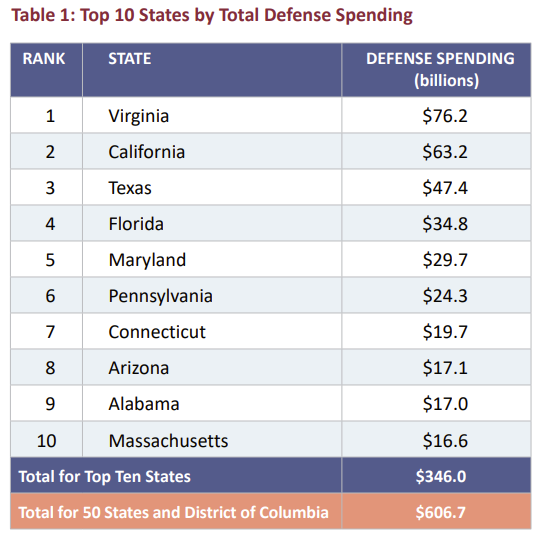
These are some staggering numbers, with Virginia ($76.2B), California ($63.2B), Texas ($47.4B), Florida ($34.8B), and Pennsylvania ($24.3B) being notable examples that rely heavily on federal subsidies for weapons manufacturing. If we are going to seriously challenge U.S. imperialism, then we will need to significantly reduce these numbers. Given the economic importance of this military spending in certain “swing states,” we suspect that some potential DSA candidates like Rep. Ocasio-Cortez will attempt to sidestep the issue. There are, of course, ways to address this (e.g., a “just transition” that switches military economies into civilian economies) if one is serious and diligent.44 Nevertheless, unwinding our current system of “military Keynesianism” is a serious undertaking that we will need to address. Vague platitudes won’t cut it at this level.
DSA in the News
Before concluding, let’s talk briefly about DSA representatives appearing in the news.45 Given the recent electoral victories, it’s no surprise that mainstream news outlets have wanted to talk with DSA’s leaders, and probe a bit more into the (genuinely interesting and heavily contested) political strategy of an insurgent group of socialists navigating a complex relationship with the (deeply hated and vulnerable) Democratic Party. The people who own these news organizations, of course, would also love to either discredit DSA or (even better) confirm that it will act as a sort of “compatible left” that neutralizes itself out of obedience to its larger coalition partners.
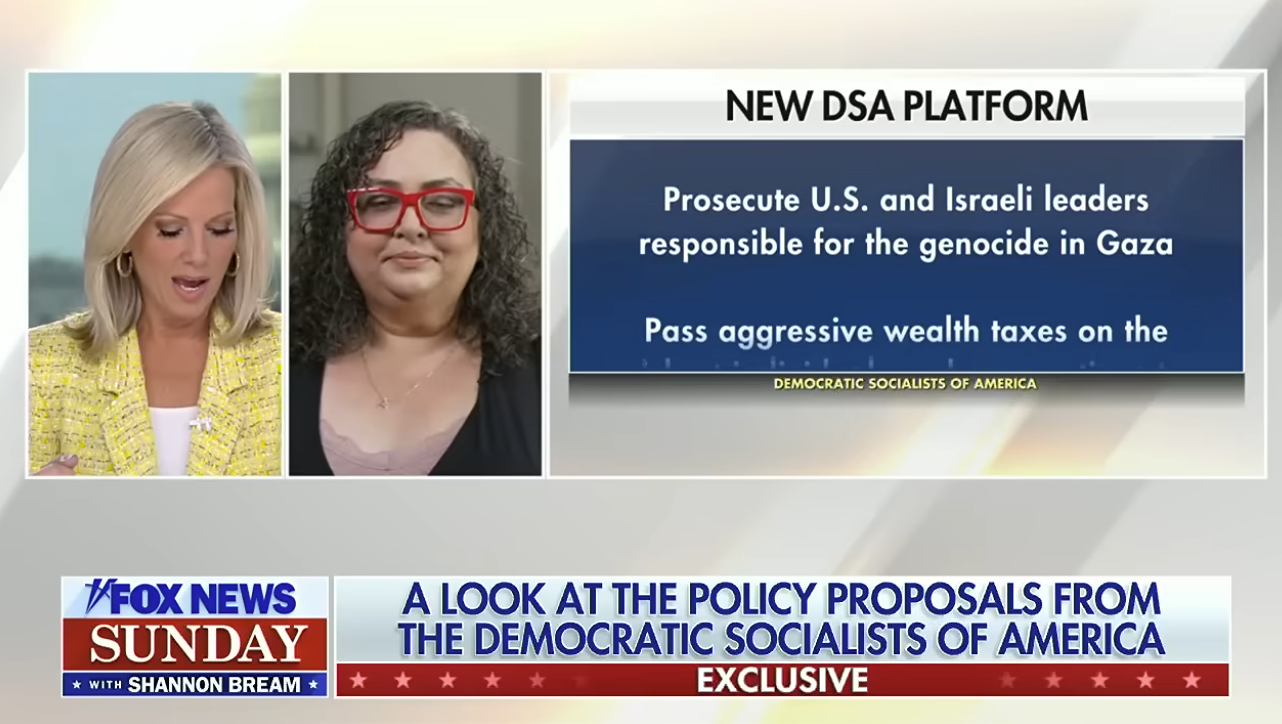
For the most part, our representatives have handled the issue of political independence from the Democratic Party pretty well. They have loudly and proudly distinguished the DSA political project from the deeply-hated Democratic Party, and have pointed out the broad failings of the party. They have also defended the organization’s independent socialist platform in the face of pressure from the (largely discredited and distrusted) media. We have been particularly heartened by the efforts of DSA co-chair and Red Star caucus members Megan Romer; when asked if she stands by DSA’s position to “Defund the Pentagon,” she cheerfully responded: “ABSOLUTELY.” She also patiently described the critical importance of controlling the means of production, the difference between our project and one of mere “social democracy,” and the Marxist distinction between the “working class” and the capitalist class. All of this is great.
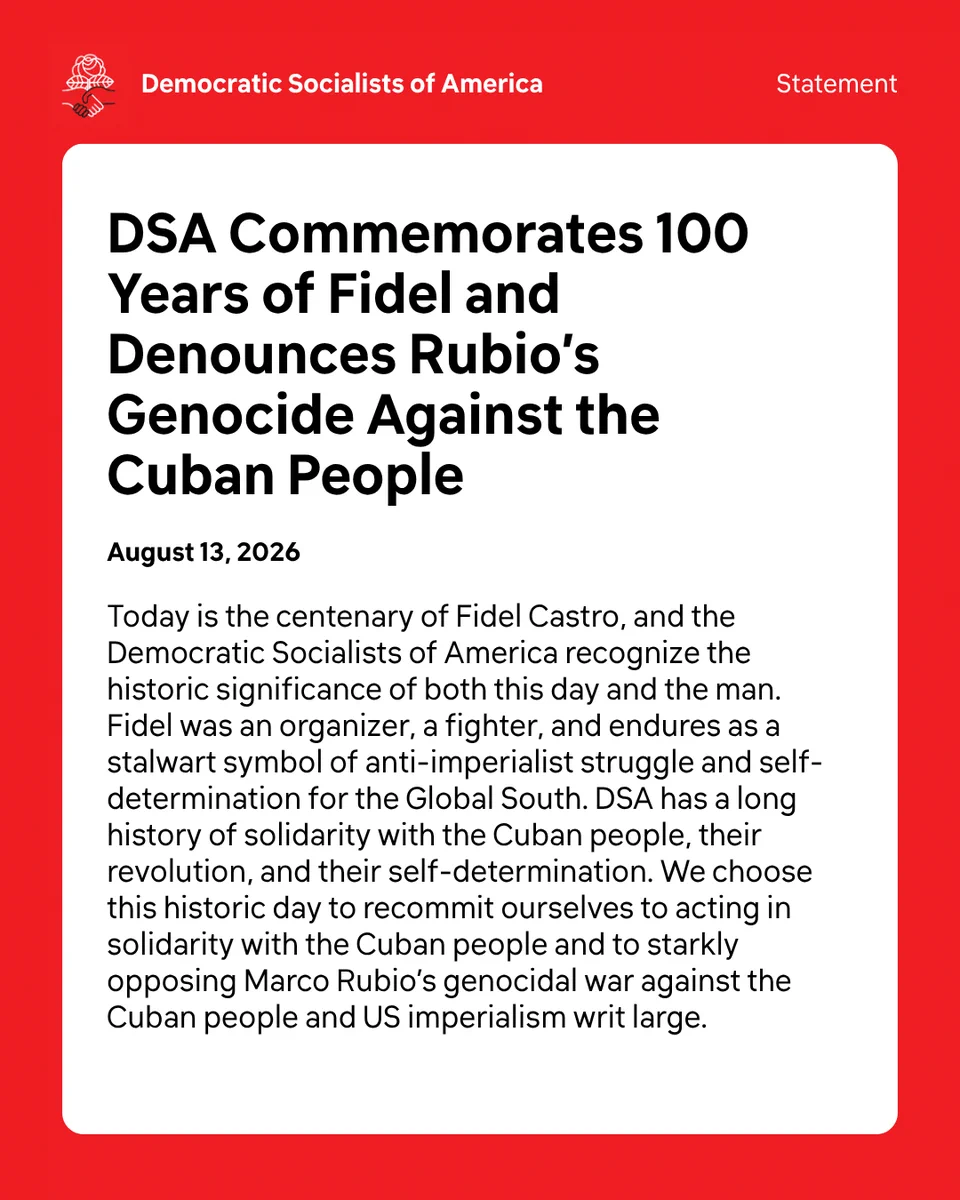
With respect to international politics, the DSA co-chair Ashik Siddique from the Groundwork caucus likewise did a good job in handling hostile interview questions on CNN regarding Cuba. One particular interview came out shortly after DSA released its August 13, 2026 statement commemorating Fidel Castro’s 100th birthday, and denouncing Marco Rubio’s campaign of harassment against anyone who tries to end his policy of cruelty against Cuba. The DSA statement was excellent, calling for the prosecution of Marco Rubio, and noting that Castro today still “endures as a stalwart symbol of anti-imperialist struggle and self-determination for the Global South.”
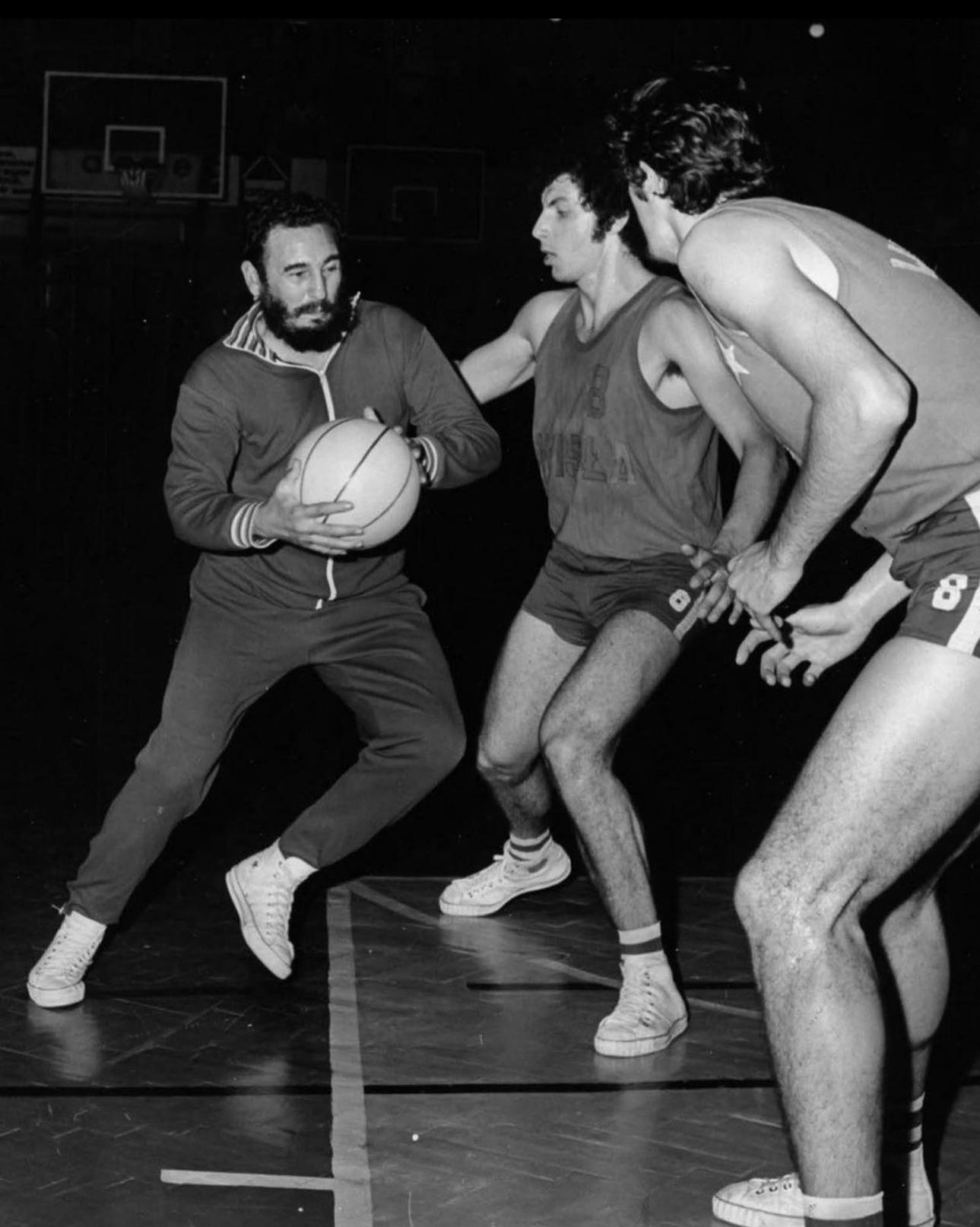
Reading this statement, the CNN news anchor was visibly mad and spent the bulk of the interview interrogating Siddique regarding his views on Fidel Castro as a sort of demonized avatar for socialism. To his credit, Siddique made the point that military intervention and economic blockades are affirmatively harmful, and that a more reasonable way to help the people of Cuba (if the host was sincere in wanting that) would “start by going back to the opening up, the economic reform that happened under the Obama administration.” Siddique even affirmatively defended the Cuban project:
SIDDIQUE: Many people, especially younger Americans now, are looking at the history of what happened in Cuba and what it was like before the Cuban Revolution, where it was one of the most – most unequal societies in the Western Hemisphere. People lived under very brutal conditions at – under a – a power structure where U.S. corporations were profiting off of the labor of the Cuban people. So, if we're serious about expanding democracy, going back to the system that existed in Cuba before then is not the way to do it. It's about opening up political and economic reform that starts with free trade, ending the brutal embargo that, for over 60 years, under economic sanctions from the United States that have limited trade into Cuba, that has been starving the Cuban people.
It's been really brutal conditions. If we look at what's happening now, electricity is being shut down.
SANCHEZ: Sure.
SIDDIQUE: Food is being shut down.
This was a fantastic response from our co-chair. Rather than deflecting towards European social democracy, or throwing Cuba under the bus, Siddique affirmatively defended the political project.46 Good.
From there, however, the interrogation became more hostile. CNN anchor Boris Sanchez called Castro a “dictator,” made broad and unspecific allegations about “political persecution,” and then launched into a personal story. Sanchez alleged that “Fidel Castro locked my grandfather up, sentenced to 20 years for doing what you're doing now on live TV, for speaking his mind.” Sure, buddy.
There was a little bit more back-and-forth, with Siddique (god bless him) sticking to his completely correct position, pointing out that “the revolution in Cuba led to an expansion of things like universal healthcare” and that “Cuba exports medical care to countries that have very poor infrastructure themselves.” It was beautiful. However, let’s unpack this CNN anchor’s self-serving sob-story a bit. Who exactly was Boris Sanchez’s grandfather, and was he just “speaking his mind” when big bad Fidel Castro decided to lock him up for no reason at all?
If you look through older CNN transcripts (November 26, 2016), you’ll find that Sanchez previously stated that his grandparents “owned land” (and also “owned a store”) in Cuba that had been subjected to the land reform laws, suggesting that they were part of the upper classes. Sanchez further stated that his grandfather had “decided to organize against” Fidel Castro following his rise to power. Looking through available records, Sanchez’s grandfather appears to be a man named José Sánchez Otero (case number 578/65), who received a similar sentence in 1965. We can't say for certain, but this appears to line up. So what exactly was happening in 1965? Was it a simple case of some well-meaning people speaking their mind in the face of an evil, all powerful dictator? No, of course not. The years 1959-65 saw a wave of violence from bandidos, groups similar to the kulaks that were displeased by the Russian Revolution several decades earlier, and who actively fought against the new social order. Just focusing on 1965 specifically, the year started off with a bombing of the Niágara sugar mill in Pinar del Río (January 17, 1965), followed by an armed attack Playa Ancón (February 2, 1965), a raid on Bahía Honda (February 13, 1965), a boat attack in Havana that killed a teenager (March 18, 1965), an attempted attack on Castro (May 30, 1965), an armed confrontation by “Alpha 66” commandos (October 8, 1965), and a machine gun attack on Havana (November 13, 1965).47 This was a time of violent struggle by exactly the reactionary economic class that Sanchez’s grandfather had been a part of, against the classes that had finally liberated themselves with the help of heroes like Fidel Castro.
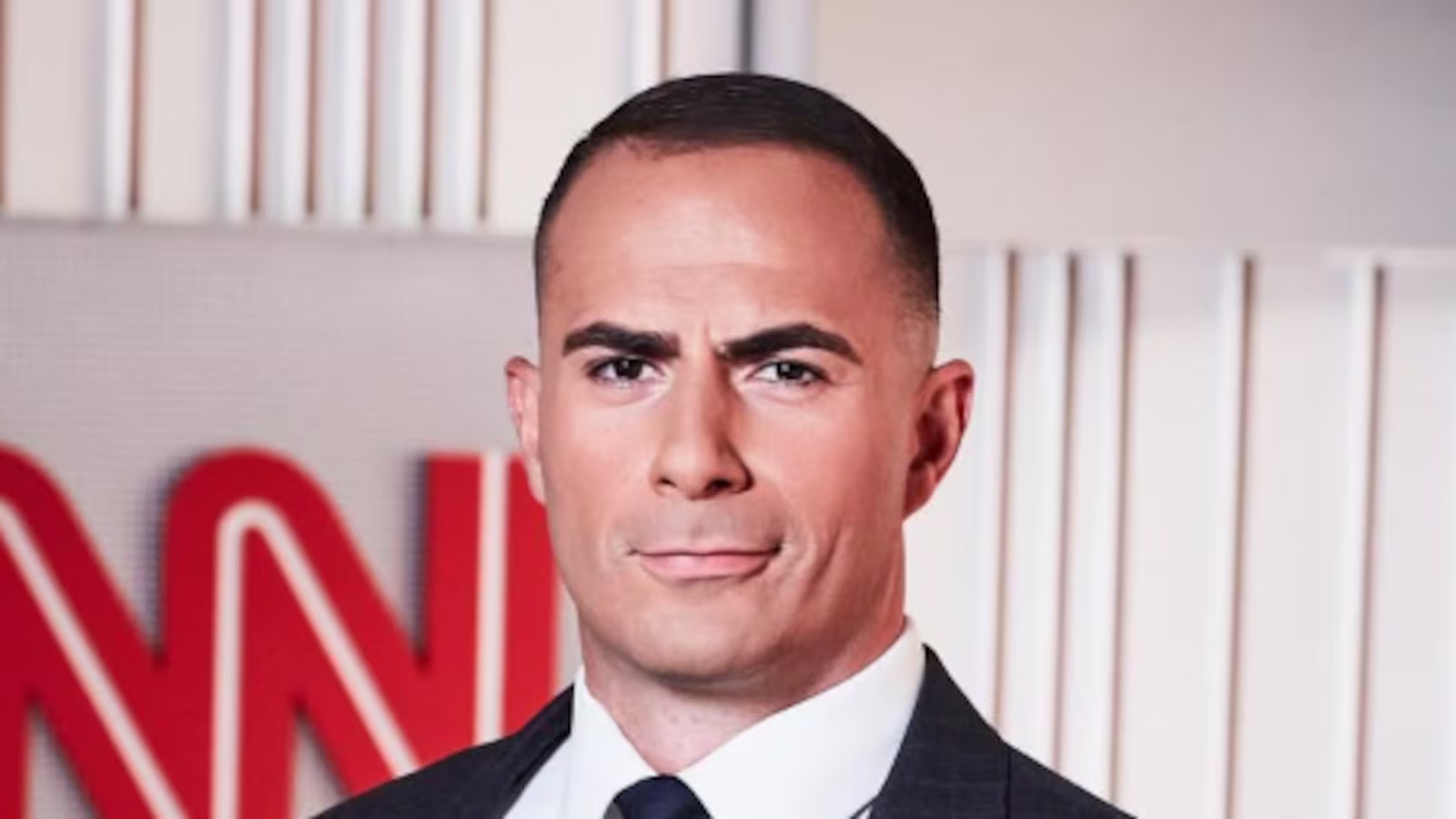
Simply put, this CNN anchor was being deceptive. Nobody should be surprised if counter-revolutionaries, trying to reimpose rule by their own economic class, get arrested when they support a violent insurrection against a socialist state. We discuss this example here simply to make the point that nobody within DSA leadership or elected office should believe these cufflink-wearing news anchors when they try to tug at our heartstrings. As socialists, we’re empathetic people, but we should never be näive. This is how their propaganda works, and it’s our job to burst through it, rather than clumsily scrambling to talk about the people of Sweden.
Conclusion
It’s not enough to have a dumbed-down platform that vaguely claims a policy of “no war.” If DSA is seriously going to contest for power at the federal level (we should), then a very specific anti-imperialist platform is the most important way that we can contest capitalism, and give breathing space to socialist projects abroad. We need to be smart and strategic, not opportunistic and näive to the Democratic Party’s obvious strategy of co-optation, and we need to be able to publicly defend our socialist positions. At this moment, the election of a slate of socialists to Congress is a major opportunity to disrupt imperialist policies, and the possibility of an opportunist presidential contender is a major risk to our project.
To summarize, we have several tasks ahead of us: (i) develop clear and precise candidate questionnaires; (ii) develop clear internal political education regarding topics like NATO and overseas military bases; (iii) “call in” our newest Congressional representatives, to ensure that they keep pushing the anti-imperialist line and introduce specific legislation that makes our aims clear; (iv) develop a plan with our newly elected Congressional representatives for how they will vote on House leadership (this opportunity to distinguish ourselves from hated party leadership will pass us by if we’re not prepared); (v) clearly reject the ideological temptations that come from the opportunist consultant class and “progressive” allies; (vi) actively participate in comms training for all of our elected officials and elected leaders so that they can properly handle questions regarding DSA’s anti-imperialist platform; and (vii) develop a very specific presidential policy platform for anti-imperialist issues before our would-be candidates offer their own hodgepodge of warmed-over liberalism.
To all of our anti-imperialist comrades, now is the time to become very active in your local chapter, and at the national level.
Footnotes:
34 During the same interview, Rep. Ocasio-Cortez revealed a bit more of her own de-radicalization and lack of commitment to DSA’s political program, saying: “Millennials are not, you know, punk kids anymore. We're grown adults with mortgages.”
35 Domenico Losurdo’s excellent book, Democracy Or Bonapartism: Two Centuries of War on Democracy, addresses in more detail how the current democratic form, with its focus on electing individuals rather than political programs, has led us to these types of tactics.
36 Needless to say, we completely reject the strange analysis by our comrades in the Socialist Majority Caucus, who maintain that the very idea of “independence” is just a “fucking dopamine hit for our American lizard brains.” We think that this analysis is somewhat childish, and that it’s foolish to try to hand-wave away and rationalize the obvious problems of Democratic Party influence on our own ranks (including the author of that weird article). In fact, this is exactly the type of backward analysis that leads leftist movements down a dark path. Likewise, we disagree with Eric Blanc from the Bread & Roses caucus, who appeared on The Brian Lehrer Show to criticize DSA co-chair Megan Romer over her unapologetic defense of the DSA platform, and argue that the “pragmatic” approach would be to restrict a socialist organization to discussing the policies that already have widespread “mass” appeal (e.g., universal child care), and to abandon others (e.g., pushing to defund the exorbitantly-funded police that has become more unpopular in recent years). We think that people like Blanc give too much weight and deference to the “ruling ideas” and forget, as Marx noted in The German Ideology, that “the ideas of the ruling class are in every epoch the ruling ideas.” Having an independent political program serves a specific purpose, and it is often very necessary to challenge the prevailing ideas of the ruling class (as we did on Palestine); this is not just (as Blanc pejoratively puts it) “taking an ideological position for the sake of it.” And although Blanc’s comments were focused on police abolition, it is obvious that this same logic of avoidance could be applied to any number of issues, including demilitarization and winding down U.S. imperialism. In fact, this seems to be exactly the finger-in-the-wind calculus used by Rep. Ocasio-Cortez and Melat Kiros to dismiss the DSA platform on NATO. Therefore, it is especially important that we reject this kind of analysis if we want to advance anti-imperialism.
37 Two of these individuals (George Latimer and Wesley Bell) defeated DSA incumbents (Jamaal Bowman and Cori Bush), emphasizing throughout their campaigns their loyalty to Israel and commitment to militarism abroad.
38 We highly encourage the reader to look up some of the demented right-wing positions of Reps. Gregory Meeks (NY), Jared Moskowitz (FL), George Latimer (NY), Debbie Wasserman Schultz (FL), and Wesley Bell (MO).
39 On August 9, 2026, Rep. Ocasio-Cortez claimed that the victory of insurgent candidates this year doesn’t represent a rupture with failed Democratic Party politics, but rather represents “a time of renewal for the Democratic Party,” and that the newest candidates “really inject a new energy to the Democratic Party and add to the toolbox of candidates that we have to win, uh, the midterms in November.” Rather than pushing for independence or a new course, Rep. Ocasio-Cortez claimed that “uh, this really is a moment, not just in Michigan, but across the country where the party is unifying, the party is unifying, and it is focused on the November elections.”
40 Mao also warned (1926) that “a revolutionary party is the guide of the masses, and no revolution ever succeeds when the revolutionary party leads them astray.” As DSA experiences an upsurge in membership today, we need to be very careful in how we exercise our leadership.
41 To take one example, Mayor Zohran Mamdani has increasingly flattened his class analysis. Over time, his rhetoric has shifted noticeably from one emphasizing “working class” New Yorkers on the campaign trail, to a kind of universalism. In his inaugural address, for instance, he stated: “This will not be a tale of one city, governed only by the one percent. Nor will it be a tale of two cities, the rich versus the poor. It will be a tale of 8 and a half million cities, each of them a New Yorker with hopes and fears, each a universe, each of them woven together.”
42 People really need to read Marx’s Critique of the Gotha Programme, to better understand that a focus on distribution rather than production is deeply misguided, and will be harmful to our movement in the long run.
43 For a more in-depth discussion of this history, we recommend reading Blue-Collar Empire: The Untold Story of US Labor's Global Anticommunist Crusade, by Jeff Schuhrke.
44 Interestingly, the AFL-CIO (which is not always friendly on the topic of anti-imperialism) passed a resolution in 2013, urging the U.S. government to make “cuts in the military budget to be accompanied by federal policies to use money now devoted to weapons production to support conversion of military jobs to civilian purposes” to “absorb the labor force now employed in the defense sector.”
45 For anyone who is interested, you can view some of these interviews on CBS News (June 30, 2026, July 19, 2026, and August 6, 2026), CNN (June 25, 2026 and June 27, 2026), Democracy Now! (July 10, 2026), FOX News (July 17, 2026 and July 26, 2026), MS Now (July 3, 2026), The New Yorker (August 7, 2026), and The Washington Post (August 3, 2026).
46 We were less happy with how local NYC-DSA co-chair Gustavo Gordillo handled the question of Cuba under interrogation from a FOX News host. Rather than defend the Cuban project, Gordillo rapidly shifted towards insisting that DSA takes “inspiration” from European social democratic countries like Norway and Sweden (we have previously criticized Rep. Ocasio-Cortez for making this exact same shift). The FOX News host was quick to interject that these are all capitalist countries, and we encourage readers to read Torkil Lausen’s book Riding the Wave: Sweden's Integration Into the Imperialist World System. We won’t dwell on the topic here, but we find it to be harmful to see DSA leaders shy away from defending our Communist brothers and sisters in places like Cuba and China, and instead shift towards attempting to emulate the capitalist projects of various anti-Communist European countries. This is essentially conceding the point that there are “good” and “bad” socialists, and attempting to ingratiate DSA with the bad faith hosts by claiming to be one of the “good ones.” It’s bad, and we hope that DSA representatives stop doing it.
47 In addition to the thorough documentation of these attempts from U.S. sources, you can also get additional context from Fidel Castro’s speeches on April 19, 1965, July 26, 1965, and October 3, 1965 discussing the counter-revolutionary attacks.