
DSA Foreign Policy and the Case of AOC

In February 2026, Rep. Ocasio-Cortez spoke at the Munich Security Conference and at Technische Universität Berlin to lay out (more or less) her foreign policy vision. Given that Rep. Ocasio-Cortez is once again requesting NYC-DSA’s endorsement, it’s necessary for DSA to grapple with the foreign policy perspective we can decipher from these speeches. This guide will examine the good (which we intend on covering fairly) and bad of these speeches, and put all of this into context so that the organization can better strategize around its own vision of foreign policy, and decide how to relate to Rep. Ocasio-Cortez at the upcoming endorsement forum on March 31, 2026.
For those who are interested, these three speeches can be viewed here:
- Panel on the Rise of Populism (Munich, 2/13/26)
- Seismic Shifts in Foreign Policy (Munich, 2/13/26)
- The Future of U.S. Politics (Berlin, 2/15/26)
A Very Brief History of Rep. Ocasio-Cortez’s Time in Office
Over the past decade, DSA has made progress towards both dethroning establishment Democrats and de-stigmatizing the word “socialism.” In both of these fights, the role of Rep. Ocasio-Cortez has been undeniable. In her initial push to the national stage in 2018, Rep. Ocasio-Cortez channeled DSA’s insurgent energy with demands to abolish ICE, implement Medicare For All, and pass a Green New Deal. Even after defeating high-ranking Democrat Rep. Joe Crowley, Rep. Ocasio-Cortez continued to push against party leadership, even participating in a sit-in protest inside Rep. Pelosi’s office in November 2018.¹ Things were looking good, and appeared to be trending towards open socialist opposition to Democratic party establishment figures.
One thing that was curiously absent from her 2018 campaign, however, was a well-defined socialist foreign policy platform. Looking through archived copies of her campaign website from 2018, it’s notable how little Rep. Ocasio-Cortez had to say about the rest of the world. This was all the more notable given that her opponent, Rep. Crowley, had literally voted for the Iraq war in 2002 and was vulnerable to popular anti-imperialist messaging. Of course, Rep. Ocasio-Cortez made some generic comments during the campaign about wanting a “peace economy,” but her campaign team also deleted the entire “foreign policy” section of her website (generic though it was) in the run-up to the election, signaling a bit of fear. To the extent that “forever war” was discussed, it was primarily to weakly insist that the President ask Congress for permission before engaging in new conflicts.
Because she was openly campaigning as a socialist, it was assumed by many that Rep. Ocasio-Cortez would have a strong anti-imperialist foreign policy viewpoint, and that more details would be coming eventually. This was reinforced by the fact that Rep. Ocasio-Cortez was capable of breaking a major taboo by saying an obvious thing: that Israel’s murder of civilians in Gaza was bad and that U.S. politicians needed to show some “moral courage” by likewise stating the obvious. At the time, it was rare and refreshing to hear a member of Congress say this out loud. Beyond that, the absence of a foreign policy vision was largely given a pass; people understood that she might just be soft-pedaling these issues to get past the gatekeepers. It was understandable that hot-button international foreign policy issues might be avoided, in favor of bread-and-butter issues that connected with voters more directly.
Nevertheless, some of the first cracks began to appear in a July 2018 interview for PBS Firing Line. The interviewer pressed against Rep. Ocasio-Cortez’s social media description of Israel’s most recent actions in Gaza as a “massacre,” and noted that she hadn’t really articulated a clear foreign policy position. Rather than giving a strong response, however, Rep. Ocasio-Cortez had a disappointing “deer in the headlights” moment. Her response was apologetic, filled with nervous laughter, defensive insistence that “I believe absolutely in Israel’s right to exist,” and commentary that “this is not a referendum, I think, on the state of Israel.” To the extent that she could articulate any criticism, it was through generic slogans about “humanitarian” concerns, and a stumbling explanation that “Palestinians are experiencing difficulty in access to their housing and homes.” Defeated, she ultimately confessed to PBS that “I am not the expert [laughing] at geopolitics on this issue.”
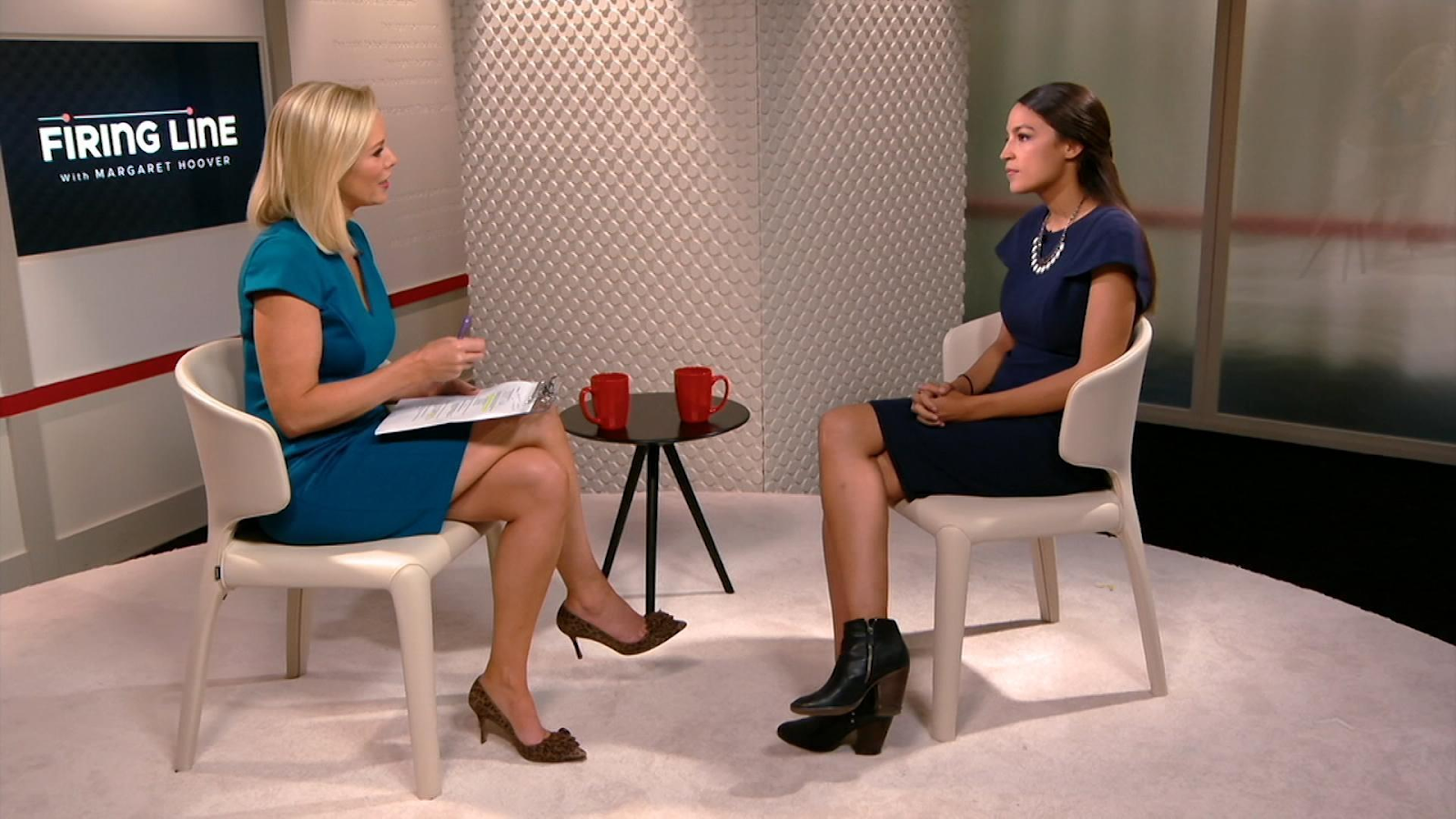
Rep. Ocasio-Cortez: “I am not the expert [laughing] at geopolitics on this issue.”
Of course, there is more to Congressional politics than just the “bully pulpit.” There are also votes and floor speeches. On this note, Rep. Ocasio-Cortez also made a very bad decision in September 2021 when she declined to vote against $1 billion in military funding for Israel’s “Iron Dome” missile system. As the New York Times reported at the time, Rep. Ocasio-Cortez “was seen weeping on the House floor after she switched her vote from ‘no’ to ‘present’” under pressure from wealthy elitist Democrat Rep. Pelosi (the same person that she had previously protested). After receiving substantial public backlash for her “present” vote, Rep. Ocasio-Cortez released a public “note,” in which she gave a vague explanation that she had changed her vote because she didn’t want to “permanently close the doors that we desperately need open in order to progress;” this was presumably a reference to a threat from Rep. Pelosi to “close the door” to Rep. Ocasio-Cortez’s personal advancement within the Democratic party. Sensing how unsatisfactory this “note” would be to her pro-Palestine supporters, Rep. Ocasio-Cortez meekly concluded: “To those I have disappointed - I am deeply sorry. To those who believe this reasoning is insufficient or cowardice - I understand.”
Yes, this was an act of simple cowardice. The fact is that Rep. Ocasio-Cortez caved in to pressure from leadership regarding her personal status within the Democratic party. That’s careerism, and it’s also bad political strategy that signals weakness. DSA quickly released a statement condemning the vote, expressing “disappointment” with both Rep. Ocasio-Cortez (who voted “present”) and also Rep. Bowman (who actually voted for the funding). At the time, this was a major dispute within DSA, with most of the ire directed towards Rep. Bowman, for obvious reasons. The BDS and Palestine Solidarity Working Group (created in 2019 to have “autonomous leadership”) had been particularly critical of Rep. Bowman, who was unapologetic about his vote to send $1 billion to the Israeli military. When DSA’s National Political Committee (NPC) decided in a split vote to disband the National BDS and Palestine Solidarity Working Group over its criticisms, the organization went through a difficult period. This decision (and its rather tortured justification by then-NPC member Gustavo Gordillo) was widely criticized within the organization, including dissent from official branches and working groups, and ultimately led to a partial reversal. One NPC member resigned over DSA’s “egregious treatment of the BDS Working Group.” Regardless, within all of this chaos, Rep. Ocasio-Cortez managed to largely escape a deeper criticism because she wasn’t as bad as Rep. Bowman (who ultimately lost his primary election in 2024 to Rep. George Latimer).
To be perfectly clear, Rep. Ocasio-Cortez has made some good decisions on Congressional votes over the years. For example, she voted against red-baiting legislation that would impose obnoxious anti-China and anti-Russia reporting requirements on universities (HR 5933 in December 2023 and HR 1048 in March 2025). She voted against the monumentally stupid Tiktok forced-sale bill (HR 7521 in March 2024). And when Congress passed another package of obnoxious red-scare bills in September 2024, Rep. Ocasio-Cortez appropriately voted against allocating $1.6 billion dollars toward anti-China propaganda (HR 1157), imposing restrictions on Chinese biomedical companies (HR 8333), establishing an anti-China division within the Department of Justice (HR 1398), and restricting the sale of agricultural land to people from so-called “foreign adversary” counties (HR 9456). She also voted against the McCarthyite throwback resolution “denouncing the horrors of socialism” (H.Con.Res.58 in November 2025).
It would have been nice if Rep. Ocasio-Cortez had explained any of these votes, because the reasoning matters. As Irish socialist James Connolly has noted, the “spirit in which [laws] will be interpreted” is very important. “The election of a Socialist to any public body at present, is only valuable in so far as it is the return of a disturber of the political peace.” It would have been nice to see Rep. Ocasio-Cortez offer a defense of socialism, or push back against the demonization campaigns of Congress. Instead, in between these quiet votes, Rep. Ocasio-Cortez has typically doubled-down on the demonization campaigns, finding time to join Ted Cruz in anti-China letters and voting for the House version of Marco Rubio’s stupid anti-China bill. Overall, as will be discussed in some more detail below, Rep. Ocasio-Cortez has failed to use her platform to correct the incessant anti-China propaganda (occasionally passively going along with it), and has been largely quiet on major international issues. She seems to have settled into a triangulating careerist path.
Of course, voting the right way on the bills discussed above should be the default. Each one of these was a very easy decision, and we want to credit Rep. Ocasio-Cortez for making the right choice without exaggerating the amount of courage that it takes to do the bare minimum. We also want to be clear that these votes, helpful as they were, needed more agitation. For instance, when Rep. Ocasio-Cortez voted against the Tiktok forced sale bill, her explanation was largely procedural (arguing that the vote was “rushed” and presented “antitrust and privacy questions,” without enough explanation of the “national security concerns”) rather than substantive (i.e., calling out the anti-China hysteria, tying the sale to the right-wing propagandist buyers, making the connection to pro-Palestine content, etc.). This was a great opportunity to mobilize public opinion, especially given the popularity of Tiktok and its connection to people getting direct news about the ongoing Gaza genocide. However, the opportunity was missed because of triangulation and an apparent fear of bucking leadership.
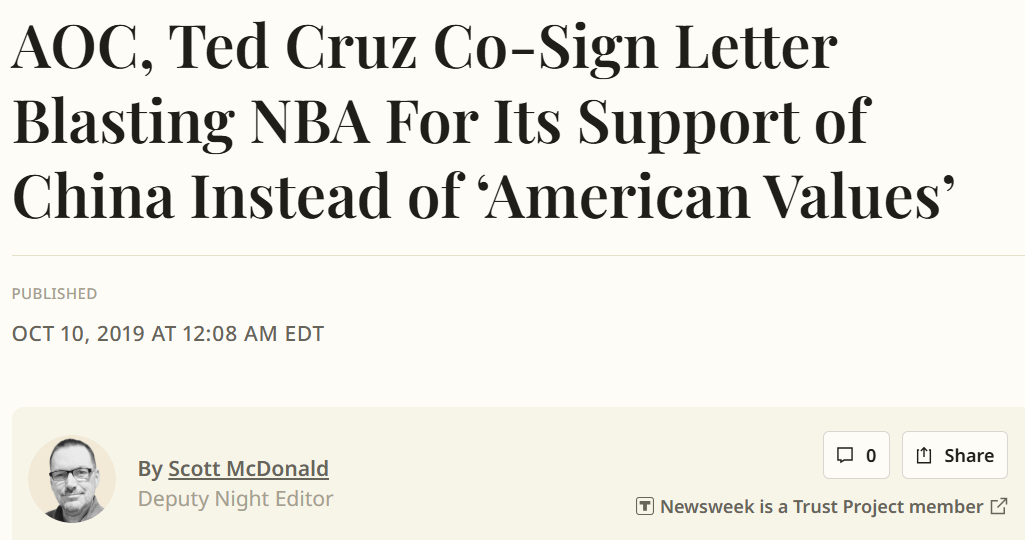
Newsweek story regarding Rep. Ocasio-Cortez’s collaboration with Sen. Ted Cruz.
Over the years, there have been many cases where Rep. Ocasio-Cortez has taken affirmatively harmful votes. For instance, she voted to expand Finland and Sweden into the right-wing NATO military alliance (HR 1130 in July 2022), break a railroad workers’ strike (H.J.Res. 100 in November 2022), pivot NATO in an anti-China direction through the Defence Innovation Accelerator for the North Atlantic (“DIANA”) initiative (HR 2670 in July 2023), claim that “denying Israel’s right to exist is a form of antisemitism” (HR 888 in November 2023), slanderously accuse Palestinians of committing “countless instances of rape, gang rape, sexual mutilation, and other forms of sexual violence” (HR 966 in February 2024), send billions of dollars in military funding to Taiwan (HR 8036 in April 2024), slanderously accuse Palestinians of using “human shields” (HR 5917 in April 2024), elevate the IHRA’s harmful definition of antisemitism as an “internationally recognized tool” (HR 1449 in November 2024), create an anti-China working group within the Department of Homeland Security (HR9668 in December 2024), conflate anti-zionism with antisemitism in connection with the Boulder attack (HR 481 in June 2025), throttle an amendment that would have restricted Iron Dome funding (HR4060 in July 2025), grant the Trump regime broad powers to go after so-called “pirates” (HR 1998 in July 2025), and sanction Chinese officials (HR 747 in September 2025). This is not even an exhaustive list, and does not even cover various other harmful positions (e.g., her cowardly withdrawal of a progressive caucus letter calling for diplomacy in Ukraine; her April 12, 2024 donation of $260,000 to the DCCC, effectively strengthening some of DSA’s worst opponents; her April 20, 2024 joint press release proudly declaring that “[a]ll of us support strengthening the Iron Dome and other defense systems”; her June 10 2024 panel discussion with an explicitly zionist organization to tone-police Palestinian organizers; and her embarrassing butt-kissing of Joe Biden in July 2024 just as opposition to the forgetful war criminal was reaching its peak).
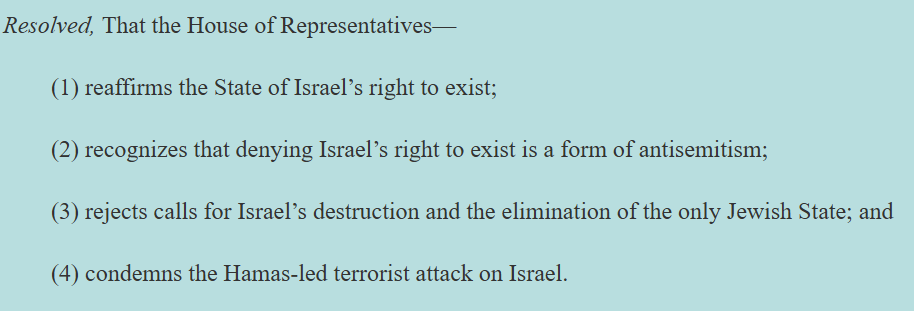

Rep. Ocasio-Cortez’s vote on HR 888, declaring that “denying Israel’s right to exist is a form of antisemitism.”
Reading all of this together, it’s hard to escape the conclusions that Rep. Ocasio-Cortez (i) lacks a well-developed socialist viewpoint on foreign policy (and is a bit naive about propaganda), (ii) is very susceptible to cowardice when pressured by the right wing of her party, and (iii) has opportunist tendencies towards just saying whatever will advance her career (e.g., supporting Iron Dome in order to maintain her status within the party, endorsing a cognitively-impaired Joe Biden in order to build clout within his non-existent second term, etc.). That’s the charitable interpretation, but it also appears to be the true one; throughout her years in Congress, we see a clear pattern of sleepwalking into some left positions only to be bullied and disciplined into falling in line. It’s a mental and moral weakness.
With all this history, there have been some disputes over the years regarding Rep. Ocasio-Cortez’s endorsement status within DSA. This all came to a head with DSA’s conditional endorsement of Rep. Ocasio-Cortez in July 2024, which was explained in this July 10, 2024 NPC statement. In brief, the endorsement was conditioned on Rep. Ocasio-Cortez opposing “all funding to Israel, including the Iron Dome,” and publicly opposing any attempts to restrict anti-zionist advocacy. Fearing that Rep. Ocasio-Cortez could not meet these basic conditions, however, and perhaps also fearing the embarrassment that would be caused when that happened, NYC-DSA withdrew its request for a national DSA endorsement, and instead proceeded with a simple local endorsement that had no conditions attached to it. Peter Sterne from City & State reported about the dispute in a July 12, 2024 article. Suffice it to say, this has been a touchy subject.
In the years since this dispute, the relationship between Rep. Ocasio-Cortez and DSA has remained somewhat tense. It certainly didn’t help that, shortly after NYC-DSA’s unconditional July 2024 endorsement, Rep. Ocasio-Cortez took the stage at the DNC in August 2024 to lie to the world that Vice President Kamala Harris was “working tirelessly to secure a ceasefire in Gaza.” By December 2024, she was begging leadership to appoint her to the Oversight Committee, and “privately signaled to Democrats that she might no longer back congressional primary challenges to her colleagues, according to three people familiar with her remarks” (leadership instead appointed the elderly and cancer-ridden Rep. Gerry Connolly who died several months after his appointment). Following that, in November 2025, she publicly took the position that “I certainly don’t think a primary challenge to the leader [Rep. Hakeem Jeffries] is a good thing right now.” In February 2026, Rep. Ocasio-Cortez “threw her support behind Rep. Julie Johnson of Texas, a Democrat who voted earlier this month for $3.3 billion in military aid to Israel and who has been actively trading stocks in Palantir.” These are just a few examples, but they’re illustrative of a politician who enjoyed the initial bump that came from a socialist organization, but who is now seeking to align herself with more right-wing forces within the Democratic party.
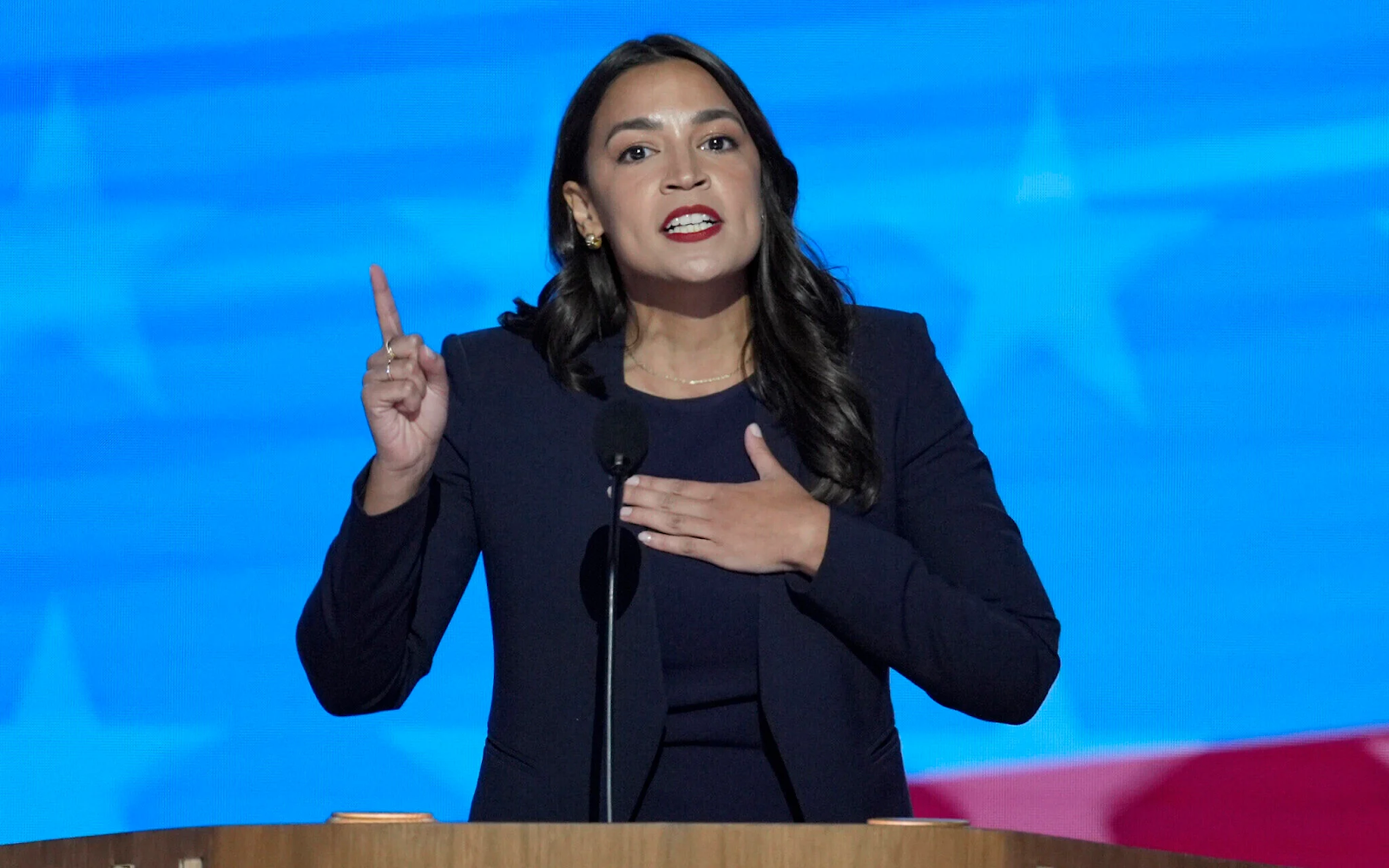
Rep. Ocasio Cortez: Kamala Harris “is working tirelessly to secure a ceasefire in Gaza.”
The Problem of the “Compatible Left”
Before moving on to Rep. Ocasio-Cortez’s foreign policy speeches, it is worth briefly touching on the topic of the “compatible left” and opportunism. Here within the United States, we have a double task of both (i) winning power as socialists, and also (ii) ensuring that we don’t get co-opted or diverted by the existing capitalist political formations (a major danger facing any leftist group within a Western country). Although some of our DSA colleagues focus on the first item, particularly in their defense of Rep. Ocasio-Cortez, the importance of addressing the second item is too often overlooked or actively dismissed. Therefore, before moving forward, it’s important to be absolutely clear about this danger.
The problem of co-optation is not a new one. In their writings, Marx and Engels frequently discussed the trend of “bourgeois socialism,” as contrasted to genuine socialism and communism. In The Principles of Communism, for instance, Engels discussed categories of (either naive or confused) individuals “who favor some of the same measures the communists advocate . . . not as part of the transition to communism, however, but as measures which they believe will be sufficient to abolish the misery and evils of present-day society.” Engels criticized these individuals as occupying an ambiguous space where they are either “not yet sufficiently clear about the conditions of the liberation of their class, or they are representatives of the petty bourgeoisie.” Strategically, Engels believed that “in moments of action, the communists will have to come to an understanding with” them, “and in general to follow as far as possible a common policy with them – provided that these socialists do not enter into the service of the ruling bourgeoisie and attack the communists.” So it is here with Rep. Ocasio-Cortez: DSA can follow a common path with her, despite her lack of clarity regarding socialism, only insofar as she does not “enter into the service of the ruling bourgeoisie and attack” the left positions.
Marx and Engels were very critical of opportunists and reformists. It is worth reading an October 28, 1882 letter to August Bebel, offering a critique of what were called the “Possibilists” (early precursors to Michael Harrington’s “left wing of the possible” ideology), together with a March 1, 1883 letter to Eduard Bernstein, objecting to the misguided strategy of “courting praise from the opponents” of socialism (an early precursor to Rep. Ocasio-Cortez’s strategy of begging for inclusion within Democratic party leadership). Throughout their writings, Marx and Engels were keenly aware of the problems posed by ambitious people who would co-opt and divert the energy of an insurgent socialist movement. They were also well aware of the negative pull that bourgeois political parties (like the Democratic Party in the United States today) can have, stating that “one thing is firmly established for all modern countries and times: to convince the workers of the necessity of forming their own independent party, opposed to all bourgeois parties.” They were critical of an approach that “preached and practices affiliation of the workers to the Liberals,” commenting on the all-too-predictable failures and backstabbing that had resulted from this approach. Even after experiencing various betrayals, they noted with dismay that groups like the Fabians would advise the working class “to remain the tail of the Liberals.”
Marx and Engels were clear that the proper approach was not simply to persuade the liberals (who have their own definite class interests) to become “socialists.” In a February 8, 1890 letter to Friedrich Sorge, Engels mocked the strategy of the Fabians “to convert the bourgeoisie to socialism and thus introduce the thing peacefully and constitutionally.” In a January 18, 1893 letter, Engels expanded on the subject, outlining the various problems with this type of misguided approach.
The Fabians here in London are a band of careerists who have enough sense to realise that the social revolution is inevitable, but who could not possibly entrust this gigantic task to the crude proletariat alone and have thus acquired the habit of setting themselves at the head. Fear of the revolution is their fundamental principle. They are the “eddicated” par excellence. Their socialism is municipal socialism; not the nation but the commune is to become the owner of the means of production, at least provisionally. This socialism of theirs is then represented as an extreme but inevitable consequence of middle-class liberalism; hence their tactics of not decisively opposing the Liberals as adversaries but of pushing them on towards socialist conclusions and therefore of intriguing with them, of permeating liberalism with socialism-of not putting up socialist candidates against the Liberals but of foisting and forcing them upon the Liberals, or cajoling the latter into taking them. They do not realise of course that in doing this they are either told a pack of lies and imposed on by others or else they themselves are lying about socialism. With great industry they have produced amid all sorts of rubbish some good propaganda writing as well, in fact the best the English have produced in this field. But as soon as they turn to their specific tactics of hushing up the class struggle, it becomes rotten. Hence, too, their fanatical hatred of Marx and all of us-because of the class struggle. These people naturally have many bourgeois followers and therefore money.
The common theme here continues, with bourgeois reformers coming from the world of “middle-class liberalism” and distorting the concepts of socialism rather than expanding on them. Engels offered further criticisms that the Fabians were motivated by “careerism” and “Liberal Party jobs.” They were “immersed up to their neck in the intrigues of the Liberal Party,” and “do everything that the workers have to be warned against.” On June 8, 1889, Engels wrote to Friedrich Sorge that the “Possibilists” had operated through “the selling of principles to the bourgeoisie for small-scale concessions,” including “well-paid jobs” on “city councils.” Again, on December 7, 1889, Engels wrote to Sorge that “the most repugnant thing here is the bourgeois ‘respectability’” politics, and on December 25, 1890 Engels criticized the “gang of intriguers and office-hunters, who have been continually betraying the Party’s true principles . . . in order to win positions for themselves and small, insignificant gains for those workers who follow them.”

Friedrich Engels, in 1889, was deeply critical of “the selling of principles to the bourgeoisie for small-scale concessions” by opportunists on the left.
This is all pretty clear, and we would do well to learn from history rather than repeat it. No analogy is perfect, but there is a lot packed in here.
It’s also quite notable that, during her trip to Germany, Rep. Ocasio-Cortez met with two political parties—the German Social Democratic Party (SPD) and The Left Party (Die Linke)—that are themselves clear examples of this “compatible left.” We won’t get into the longer history of the SPD and Die Linke, or of the politics of East Germany and West Germany, because that would be far too long of a tangent. Perhaps another time. For now, we encourage the reader to review in particular how these political parties have approached the issues of Israel and NATO.
As we noted in August 2025 (in the context of DSA’s national convention), DSA as an organization always faces the danger of “drifting into soft complicity with imperialism.” The organization has a bad history of exactly this type of opportunism and careerism, particularly in the disgraceful years under Michael Harrington where the organization was explicitly pro-zionist and opposed to the Vietnamese resistance. Harrington took the position that “the US should supply Israel with the necessities for defending itself,” and viewed his role as trying to keep the socialist left “pro-Israel.” On the topic of Vietnam, and any then-existing socialist state, Harrington was likewise deeply critical to the point of serving an important propaganda role to demobilize the socialist left. Harrington did not have a sophisticated position, but rather a simplistic and careerist one. He was a suck-up, perpetually begging for entry into the Democratic party (even during its segregationist years), and his influence was affirmatively harmful for the socialist left. The organization didn’t amount to much under his leadership, other than clearing the way for right-wing forces, and we would do well to make sure that Rep. Ocasio-Cortez doesn’t clear the way for Trump to conduct his anticommunist Cold War 2.0 in the same way that Harrington did for Reagan during the first Cold War. We can’t shift the Overton Window to the right on international politics, especially when there are so many great opportunities staring us in the face.
We have previously written in May 2025 (in the context of Trump’s tariffs) about the shifting location of world production and how that impacts organizing within the United States. We also wrote in February 2026 (in the context of the attacks against Venezuela) about the dangers of people within DSA promoting anti-socialist propaganda in order to “fit in” with Democratic establishment figures. We encourage you to read (or re-read) those prior statements for additional context. For now, we’ll just say that it’s incredibly important to see very clearly the danger of DSA falling into these opportunist traps, because we can’t win socialism by selling out those who are actively fighting against United States imperialism. There is much more to say about the terrible pseudo-socialist examples of Vic Berger and Michael Harrington, and the Cold War project of building up a “compatible left” to fight against the very real power of the Communist left, but we will leave that for another day.
Suffice it to say, this is a very real challenge facing our movement. Deeper analysis is important, and we’re not just shooting from the hip in order to elect anyone who seems vaguely “progressive.” We have seen political hacks selling Ritchie Torres and John Fetterman (with the help of media consultant Morris Katz) to the public as “progressives.”² Even though people have fallen for this nonsense before, it’s always important to remind our fellow DSA members that this is about real analysis rather than just “vibes.” In this spirit, the following exchange from January 2019 is worth revisiting:
Anderson Cooper: When people hear the word socialism, they think Soviet Union, Cuba, Venezuela. Is that what you have in mind?
Rep. Alexandria Ocasio-Cortez: Of course (LAUGH) not. What we have in mind— and what of my— and my policies most closely re— resemble what we see in the U.K., in Norway, in Finland, in Sweden.
In short, Rep. Ocasio-Cortez rejects actual examples of socialism around the world, and instead identifies more with the “socialism” of the British. With this context, we need to apply a critical lens so that we aren’t made into fools.

Rep. Ocasio-Cortez appears on 60 Minutes to reassure Anderson Cooper that she does not have a radical outlook.
Bad Analysis and Confusion from Rep. Ocasio-Cortez in Germany
The Munich Security Conference is a pro-NATO conference, which serves as a venue for individuals from NATO member countries to exchange ideas about how best to control global politics. It was founded in 1963 during the Cold War as an explicitly anti-Communist organization, where the organizers gathered former and “rehabilitated” Nazis to discuss how best to use nuclear threats against the Soviet Union. The history isn’t a good one, and the common thread throughout the conference’s existence has been anti-Communism. It’s also revealing that the conference this year was sponsored by Lockheed Martin, Raytheon, and BAE Systems.
Rep. Ocasio-Cortez chose this as the forum to showcase what she thought would be her foreign policy chops, and the choice of the venue is itself somewhat revealing because it appears to display a bit of a “pick me” energy within the United States empire.
This could have been an opportunity to go into the belly of the beast, and to speak hard truths directly towards those who are trying to colonize the world. To be sure, there were indeed some good points in the speeches. For instance, Rep. Ocasio-Cortez described NAFTA as “a failed policy for many rural and working class communities,” criticized the Trump regime’s approach to using tariffs, pointed towards the “corporate protectionism” built into trade agreements (e.g., the patents terms of TRIPS), and was at least somewhat skeptical of Trump’s posture towards China (cautiously calling it “a little conflict driven”). She even criticized Israel’s “genocide in Gaza,” which (in a bit of an understatement) has killed “thousands of women and children.” However, most of this was either clearing a very low bar by stating the obvious (on topics where even her Democratic party colleagues agree), or was hopelessly vague (most of it). In any event, her speeches in Germany were most noteworthy because of the bright red flags that were displayed. Although Rep. Ocasio-Cortez cautiously tiptoed around most topics, she clearly signaled her common purpose with the Munich Security Council. The following sections will discuss in more detail Rep. Ocasio-Cortez’s treatment of the Western “rules-based order,” Venezuela, Taiwan, NATO, and USAID.
The “Rules Based Order” and Unipolarity
The phrase “rules based order” (or “RBO” or “liberal international order”) has a specific origin and meaning. It’s not just a general phrase that broadly refers to obeying international law; instead, the “rules based order” is a Cold War concept that more-or-less refers to the political and economic world system promoted by the United States following World War II (with the World Trade Organization, International Monetary Fund, and other institutions undergirding a global capitalist economic systems). Of course, academics can argue over the phrase in political science classes, but it’s generally understood that this is a kind of code phrase for Western hegemony (under the implicit leadership of the United States). Some call it “imperialism by another name,” and it is widely understood by Marxists and socialists that the “rules based order” means international capitalism.
With this background, it was very troubling that Rep. Ocasio-Cortez made the “return” to the “rules based order” one of the centerpieces of her foreign policy pitch: “I think what we are seeking is a return to a rules-based order.” Of course, even though she made these remarks in the context of critiquing Trump’s inconsistent application of the “rules” (a point that is as correct as it is obvious), the framing of the “rules based order” as the guiding principles for international relations is very bad and pregnant with anti-socialist implications.
The analysis that Rep. Ocasio-Cortez offered to the conference regarding Trump’s “retreat” from the RBO was also troubling. According to Rep. Ocasio-Cortez, Trump is “looking to withdraw the United States from the entire world so that we can turn into an age of authoritarianism.” According to Rep. Ocasio-Cortez, Trump’s goal is to “carve up” the planet into different spheres of “authoritarianism.” At first blush, this is just obviously wrong; there is no indication that Trump is “looking to withdraw the United States from the entire world.” Quite the opposite, Trump has been overextending himself all across the planet, and even attacked Iran just weeks after Rep. Ocasio-Cortez’s remarks (in a funny echo of how Rep. Ocasio-Cortez had said that “Joe Biden is our nominee” and “is not leaving this race” just weeks before he left the race during his cognitive downward spiral). It’s true that Trump has been hyper-focused on the Western hemisphere in recent months, but that is only because he had been defeated in his attempts to bully China with tariffs. The goal is still obviously worldwide extension, even if the pace is different in different regions.
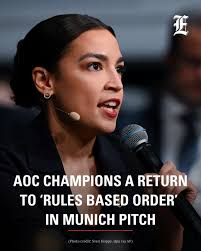
Washington Examiner reports on Rep. Ocasio-Cortez championing of the “rules based order” in Munich.
Beyond that, what did Rep. Ocasio-Cortez mean when she said that Trump was looking to have a globe where unnamed “authoritarians” would “carve up” different regions of the globe for their supposed dictatorships? In order to decode this gibberish, we can look to the comments from that clumsy doofus Matt Duss, who has served as a “tutor” to Rep. Ocasio-Cortez on foreign policy:
When trying to interpret or impose a strategic logic onto Trump’s foreign policy, it’s important to remember that Trump is first and foremost interested in himself and his family’s financial interests. Thus far in his second administration, while he certainly seems more comfortable with the idea of allowing militarily powerful countries set rules in their regions — whether with Russia in Europe, China in Asia, or Israel in the Middle East — he still clearly believes that they should accept a global security order largely determined by the United States.
Given that this is Rep. Ocasio-Cortez’s sloppy foreign policy guru, one can infer that the other “authoritarians” she had in mind from her Munich speech were China and Russia. Of course, this is obviously some stupid Cold War 2.0 nonsense, which deserves all the disrespect that we can muster as an organization. The problem is most certainly not that China and Russia are “authoritarians” who need to be reined in by the so-called “rules based order.” This is an obnoxious thing to suggest (dangerously close to neoconservative framing), and it’s doubly obnoxious because she chose to bury this message so deep out of awareness of its unpopularity.
Importantly, what we see here is Rep. Ocasio-Cortez blindly stumbling through an articulation that rejects multipolarity on the world stage. She is clearly trying to remember notes that she had reviewed (she had prepared for months), but at this point it’s hard to miss the core message that seeks to impose a single unipolar world order. Her “tutors” have instructed her specifically against a world stage that allows for greater regional independence from Western “leadership,” and that is a dangerous philosophy. This is not a subtle point, it is a big one.

Chinese President Xi Jinping walks with Brazil’s President Lula da Silva in Beijing.
Repeating Propaganda Against Venezuela
In her speeches, Rep. Ocasio-Cortez made some embarrassing factual errors regarding Venezuela. For instance, she said that Venezuela “is below the equator” even though it is north of the equator. Likewise, she falsely said that Venezuela had “canceled elections” when that is simply not true. That isn’t even something that the right-wing argues, because it’s flat-out false. Even aside from these errors, however, the analysis was simply confused.
We look at what happened in Venezuela for example, it is not a remark on who Maduro was as a leader. He canceled elections, he was an anti-democratic leader. That doesn’t mean that we can kidnap a head of state and engage in acts of war just because the nation is below the equator. And, um, it, and by the way, Rubio and the Trump administration left Maduro's regime intact. And, so, even whatever moralizing they have about it, they’re just as much a culprit in ignoring the election results as anybody else.
We have already discussed the Venezuela example at length here, but need to emphasize how terrible this commentary is. Of course, it’s helpful that Rep. Ocasio-Cortez suggested that the “kidnapping” of President Maduro was something negative (she’s right to call it “kidnapping”). However, she also devoted equal time to providing a bit of justification for it by mindlessly repeating the propaganda that President Maduro was “anti-democratic” (she very carefully refers to him as the “head of state” running a “regime,” to avoid using his real legal title of “President”), and even suggested that Trump was acting in an “anti-democratic” manner himself when he “left Maduro’s regime intact.” There has been a bit of debate over the ambiguity in Rep. Ocasio-Cortez’s phrasing here, with some suggesting that she was only commenting on Trump’s hypocrisy. However, it’s hard to escape the similarities between this phrasing and how Sen. Schumer has, for years, criticized Trump because “he hasn’t brought an end to the Maduro regime.” The Democratic party, whose leadership Rep. Ocasio-Cortez is always desperately courting, has been using this exact framing to softly smuggle into the public consciousness a liberal justification for deposing Venezuela’s President. When Rep. Ocasio-Cortez makes Schumer’s same argument, and fails to make clear statements demanding the release of President Maduro (a man that she constantly slanders), it is very troubling. It also has echoes of Rep. Ocasio-Cortez’s triangulation around Cuba, where she likewise condemned the government as “anti-democratic.” She is factually wrong, and seems to think that by parrotting the Democratic party line on this she will be allowed into their club. This is naive, at best.
In our assessment, Rep. Ocasio-Cortez is clearly a bit of a cynical opportunist on this issue, always trying to have it both ways and do whatever it takes to avoid making various parties (both the socialist left and the party establishment) too mad at her. It’s political cowardice, and it betrays a bad tendency to outsource critical thinking to sloppy advisors like Matt Duss (who similarly made all kinds of slanderous allegations against President Maduro on his podcast, discussing with his guests how best to depose President Maduro with non-military means). This certainly isn’t international socialist solidarity, and it certainly isn’t a profile in courage.
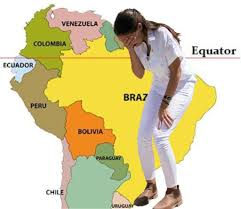
Rep. Ocasio-Cortez and the northern hemisphere country of Venezuela
Confusion Regarding China’s Relationship to Taiwan
The issue of Taiwan is straightforward. When Mao Zedong and the Communist Party decisively won the Chinese Civil War against the brutal right-wing regime of Chiang Kai-shek, they drove the right-wing Kuomintang (KMT) forces into retreat. The KMT largely settled on the island of Taiwan, where their descendants have—for decades—attempted to court United States support to build a new breakaway republic. For years, the KMT attempted to pose itself as the so-called “Republic of China” (ROC) and claim ownership not just of the island of Taiwan, but also the whole mainland. This was obviously ridiculous, but the same right-wing NATO ghouls who established the Munich Security Forum during the Cold War propped up the fiction that the KMT and ROC “controlled” China and were its rightful (capitalist) owners. This ridiculous and aggressive foreign policy posture only lasted a little while, though, until President Nixon normalized relations with the real Chinese government (the People’s Republic of China or “PRC”) in 1972, and the United States ultimately recognized the obvious as US policy: there is only one China, and the PRC is the legitimate government. Notwithstanding the normalization of relations with the real Chinese government, the duplicitous United States has consistently flirted with a more ambiguous or hostile posture towards Taiwan over the years. The batshit end-times right-wing in the United States (together with elitist Democrats like Nancy Pelosi and Hakeem Jeffries) would love to see a breakaway right-wing republic start a war against China, and is only too weak to make it happen in reality.
During her German trip, Rep. Ocasio-Cortez had another embarrassing moment when she was asked about the United States policy towards China and the right-wing forces that flirt with arming a breakaway republic in Taiwan. She once again looked like a deer in the headlights, trying to remember the details of her notes, in the following exchange.
Francine Lacqua: Would, and should, the U.S. commit U.S. troops to defend Taiwan, if China were to move?
Rep. Ocasio-Cortez: Um, you know [pause], I think that [pause] this is such a [pause], you know, I think that [pause] this is a, um [long pause] — this is, of course, a, uh [pause], very long-standing, um [pause], policy of the United States. Uh, and I think what we are hoping for is that we want to make sure that we never [pause] get to that point, and we want to make sure that we are moving in all of our economic, research [???], and our global positions to avoid any such confrontation, and for that question to even arise.
This was an awkward and confusing moment. What exactly is the “very long-standing, um, policy of the United States”? It’s definitely not clear here. And what do our “research positions” have to do with any of this? What does that even mean? It’s word-salad. You also need to remember that this is the batshit right wing’s hobby horse: they’re obsessed with imagining the United States military going to war with China, and they’re always trying to bait the Democrats to go along with that ridiculous, apocalyptic anti-Communsit posturing. The right response to this is to push back against the premises of the question. Even though war against China might be a more popular position within the Munich Security Conference of wealthy weirdo imperialists, going to war with China over Taiwan (in a potential right-wing capitalist breakaway) would be deeply unpopular in the United States and across the world. It would have been positively good for Rep. Ocasio-Cortez to firmly shut down this possibility and treat it with a bit of scorn. She would have had to do a bit of work to normalize the idea, and she would have to understand it (something she should have been working on during her many years in office), but just because it’s easiest career-wise to cave in to this monstrosity doesn’t mean that she should do it.
During his twilight years in the Presidency, these same monsters elder-abused Joe Biden into making even worse comments about war with China over Taiwan, and it’s a shame that Rep. Ocasio-Cortez is sleepwalking in the same direction out of naivety. And we should never forget that this isn’t just rhetoric: Rep. Ocasio-Cortez previously voted to send billions of dollars in military funding to Taiwan (HR 8036 in April 2024).
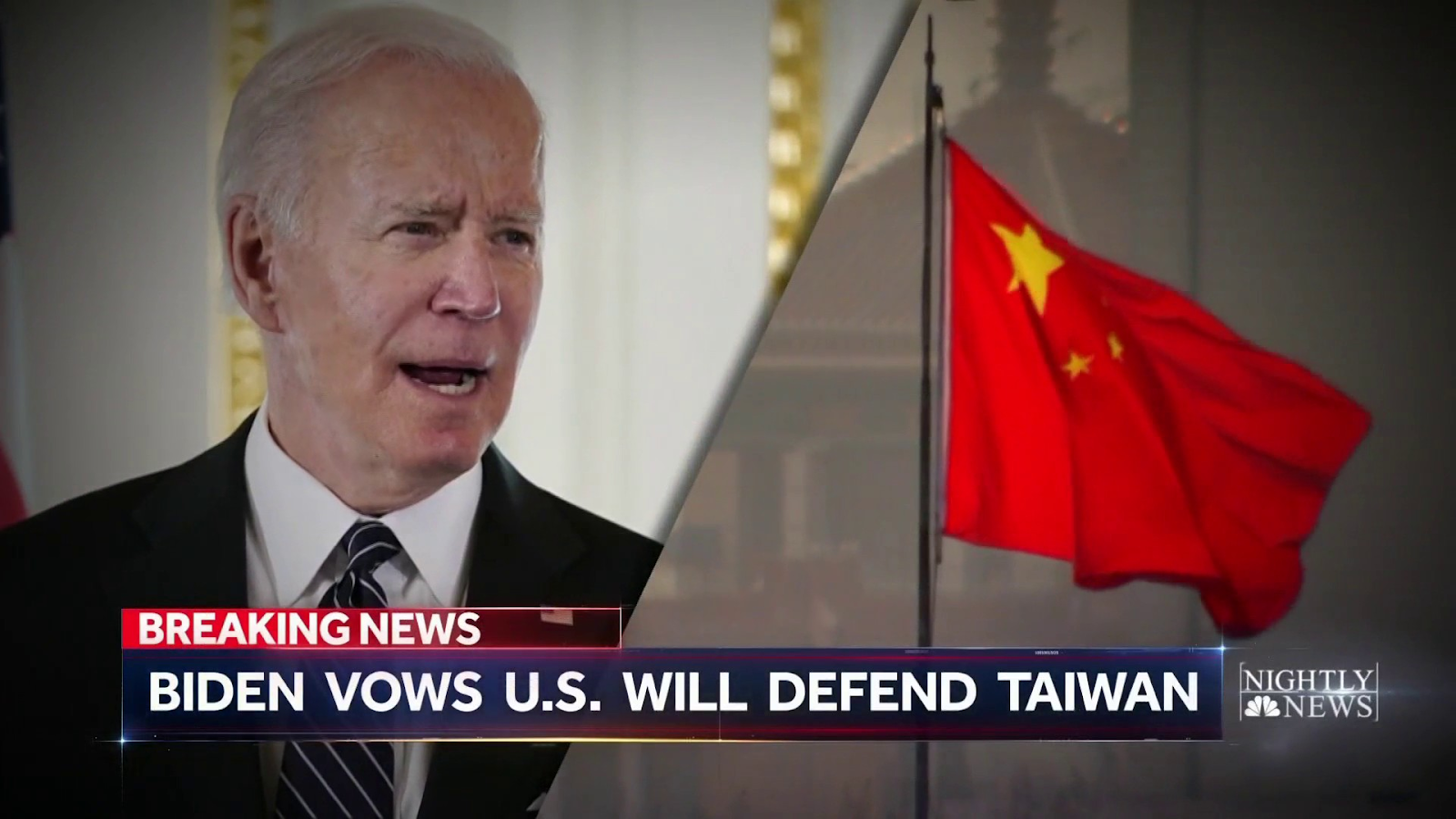
President Biden, after supporting various arms sales to Taiwan, stupidly announced his intention to attack China in the event of a regional dispute.
Reckless Pro-NATO Positioning
The DSA International Committee's position on NATO is absolutely clear. In a previous statement from June 2021, the organization called for full opposition to NATO (a Cold War relic), and stated plainly that the “United States should immediately withdraw from NATO.” DSA IC provided a clear and well-explained set of reasons that everyone should read themselves.
Rep. Ocasio-Cortez’s position on NATO, however, is directly opposed to DSA IC’s position. As discussed above, Rep. Ocasio-Cortez has already voted to expand Finland and Sweden into the right-wing NATO military alliance (HR 1130 in July 2022). Likewise, her endorsement of the so-called “rules based order” translates into support for NATO (as one of the key entities trusted to enforce the so-called RBO). When asked at the conference if she would want to “save” NATO, she responded affirmatively that she did indeed want to see a stronger “trans pacific partnership" (she later retracted this statement online to say that she really meant to say “transatlantic partnership,” a reference to the North Atlantic Treaty Organization) as a “hard stop against authoritarian” countries like Russia.
For context, the Munich Security Conference in Europe is also savagely supportive of fighting war against Russia “to the last Ukrainian.” Given its Cold War origins, it’s no wonder that this enclave jumps at the chance to relive its glory days of battling the Soviet Union. In fact, Ukrainian President Volodymyr Zelenskyy (a man who literally did cancel elections, unlike President Maduro who won elections) was a keynote speaker at the conference, where he compared President Putin to Adolph Hitler, insisted that he wasn’t losing the war, and begged the weapons-dealers in attendance to please support him more. It was a bit pathetic, and mirrored by wave after wave of white European leaders making very similar moralizing speeches.
When Rep. Ocasio-Cortez spoke on the topic, she joined the chorus of the Munich Security Conference, and also mimicked the position of the Democratic party within the United States. During her speeches, Rep. Ocasio-Cortez reiterated the good-versus-evil framing that the Democratic party has been promoting, and even came across a bit worse than Trump himself (no small feat).
There's no conversation about Ukraine that can happen without Ukraine. And so they, of course, lead in terms of setting their terms on this. But I think that, overall, as a principle, we shouldn't reward imperialism. And I don't think that we should allow Russia to continue, or any nation to continue, violating a nation's sovereignty and to continue to be rewarded, and whose main lesson and takeaway is that they will gain. And so what that looks like in the specifics, I think is a deeper conversation, but on principle, I think that is what we should be pursuing.
Wait, what exactly should we “be pursuing”? And how does Rep. Ocasio-Cortez propose to regulate what is or is not “allowed” of Russia? Even though this is vague, what she is saying seems to be that NATO should beat back Russia, and more-or-less continue the destructive policies of our former President Biden. When she says that we shouldn’t “reward” Russia, what she is saying is that we shouldn’t negotiate with Russia, or recognize any of its legitimate interests in the conflict. In this worldview, any concessions to their position would be “rewards,” and only Ukraine should be “setting their terms” for the end of the conflict. This position is pure madness, and a recipe to just continue what forgetful Joe Biden did during his one and only shameful term in office.

Rep. Ocasio-Cortez on President Joe Biden (July 2024): “President Biden has made clear that he is in this race. The matter is closed. Biden is our nominee. He is in this race and I support him.”
It is worth remembering that, during the height of President Biden’s term in office, Rep. Ocasio-Cortez was described by Time magazine as “one of Joe Biden’s most valuable boosters.” During his failed campaign, she appeared on the “I’ve Had it” podcast where the hosts asked Rep. Ocasio-Cortez: “Had it” or “Hit it” for Joe Biden? Embarrassingly, Rep. Ocasio-Cortez replied with enthusiasm: “Hit it!”
Rep. Ocasio-Cortez, for her part, has largely participated in the Democratic party’s stupid mania over Russia. Of course, she has at times taken some sensible votes, such as her vote against a broad Russia sanctions bill (HR 6930 in April 2022). However, by May 2022 she voted in favor of a $40 billion military aid package to Ukraine, and has largely been on the same path ever since. The trajectory of her approach here is particularly instructive. Much like her initial opposition to Iron Dome funding that was flipped by party leadership, Rep. Ocasio-Cortez’s early sanity on this issue was clearly “disciplined” to the point where the careerist politician has largely fallen in line. As discussed above, the Progressive Caucus released an October 2022 letter, which—even though it bragged about supporting military funding—had the good sense to recommend diplomacy to end the conflict. Under pressure from leadership, the cowardly Progressive Caucus retracted even this milquetoast letter.
Rep. Ocasio-Cortez’s Munich Security Conference remarks are perhaps best seen as her attempt to ingratiate herself with the Europeans and USians who are driving and prolonging the conflict in Eastern Europe. Even though she was super-vague about the details of her policies, Rep. Ocasio-Cortez’s clear message to this crowd was that she was on their side.
The DSA position on the conflict between Russia and Ukraine has also been fairly clear, although admittedly a bit muddled at times due to internal disputes. Importantly, the organization has repeatedly made it clear that it seeks a negotiated settlement to the conflict that recognizes legitimate grievances on both sides, and—contrary to the Democratic party position—openly opposes NATO and its positioning that has prolonged the conflict.
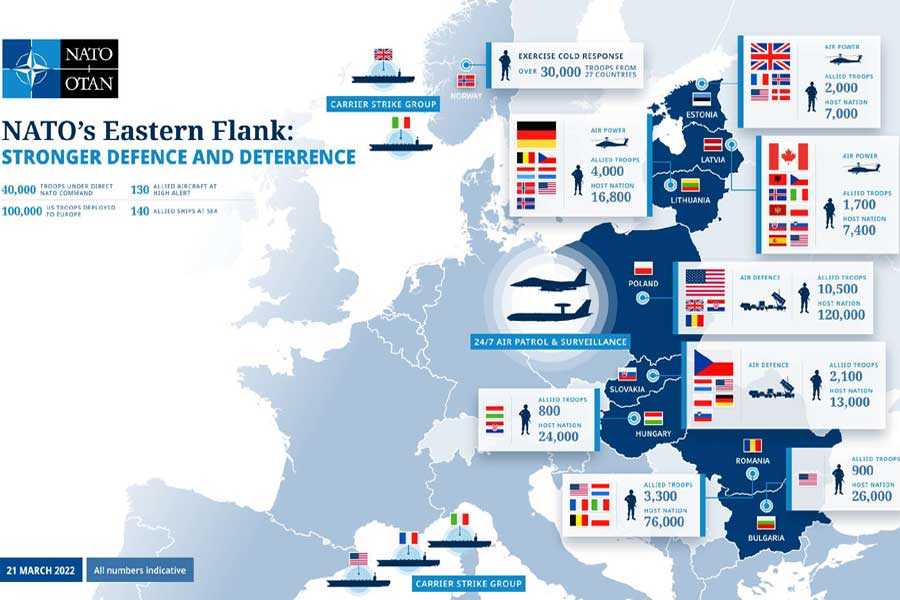
Graphic from 2024, displaying NATO’s expanding military presence eastward.
We won’t discuss the entire history of the conflict, except to mention that it largely stems from a dispute regarding trade agreements back in 2013. The United States and Europe had been pushing vigorously for Ukraine to sign the “European Union–Ukraine Association Agreement,” but the agreement fell apart—as the New York Times reported on November 22, 2013—because of “the International Monetary Fund’s overly harsh terms for an aid package” that would accompany the agreement’s signing. Essentially, the IMF and the Western powers (i.e., the same groups underpinning the “rules based order”) had been demanding harsh austerity measures from Ukraine, and an opening up to foreign capital, which would have important economic implications for Wall Street and finance capital within the United States.³ The Telegraph likewise reported on November 22, 2013 that the failure to advance this trade agreement was “the first major defeat for the EU in its eastward march since the fall of Communism.”
In order to force through these trade agreements, and block an economic alliance between Ukraine and Russia, the United States helped to overthrow the Ukrainian government in a violent coup in 2014. Although the circumstances surrounding these events in 2014 are beyond the scope of this analysis, the economic implications are worth noting. As an initial matter, Reuters reported on March 27, 2014 that Ukraine had secured a $27 billion loan from the IMF in the wake of the conflict. Stripping away the veneer of popular democratic control regarding economic decision-making, members of parliament openly acknowledged to the press that “the decision we have to take is extremely unpopular” (even though they maintained that it was “necessary”). Years later, the Atlantic Council—essentially NATO’s “think tank”—gave some further insight into the economic consequences of the transition on April 22, 2021, when it noted that Ukraine still retains 3,644 state-owned enterprises from the Soviet era, but had been engaging in “a large scale, open, and honest privatization of non-strategic state-owned assets.” The article recounted the recent history of privatization, and celebrated how the new governments since 2014 had overcome “resistance” (i.e., popular opposition) within the country and “created the conditions for a steady privatization process” notwithstanding such “resistance” (something that the Atlantic Council believes would be attractive to “potential investors”).⁴
In early 2022, following years of violence and conflict (and a failure to implement the Minsk accords), Russia sent its military into the Eastern region of Ukraine (the Donetsk and Luhansk provinces).⁵ A deep analysis of the conflict isn’t possible here, but for present purposes, the United States—with the strong backing of New York politicians close to Rep. Ocasio-Cortez—has sent tens of billions of dollars worth of weapons and military aid to further fuel the conflict (funding that could have been spent on domestic programs at home). The United States does not appear to be particularly eager to see a negotiated peace agreement. As Hal Brands, one of the war’s proponents, argued in the Washington Post on May 10, 2022, this is a “proxy war” that the United States is fighting against Russia for its own reasons. As told by Brands, “[p]roxy wars are longstanding tools of great-power rivalry because they allow one side to bleed the other without a direct clash of arms.” However, “[t]he key to the strategy is to find a committed local partner — a proxy willing to do the killing and dying — and then load it up with the arms, money and intelligence needed to inflict shattering blows on a vulnerable rival.” In this case, “Ukrainian forces are nothing if not committed; they have been willing, in many cases, to fight to the last man.” With that aim in mind, the United States has repeatedly passed military aid packages to Ukraine.
With respect to the issue of democracy, which is frequently invoked in the name of arming Ukrainian President Zelenskyy (a man who, unlike President Maduro, has actually cancelled presidential elections and opposition parties), people often fail to acknowledge that four oblasts (essentially the equivalent of “states” in Russia, Ukraine, and other former Soviet nations) out of Ukraine’s twenty-four have already voted to re-join Russia. The United States press buried this story, but from September 23–27, 2022, four oblasts (Donetsk, Luhansk, Kherson, and Zaporizhzhia) held a referendum with 97.51% turnout, in which they overwhelmingly voted in favor of re-joining Russia. The vote results in favor of re-joining ranged from 87% in Kherson to 99% in Donetsk, and it’s no wonder given the widespread murder and repression that right-wing, anti-Russia, neo-Nazi Ukrainian officials had used for the better part of a decade in the region. The United Nations estimates that there had been more than fifty thousand casualties in Eastern Ukraine between April 2014 and December 31, 2021, together with “37-39,000 injured.”

Right-wing Ukrainian forces set fire to a trade union building in Odessa, killing dozens.
In looking at the violent post-coup period (from 2014 to roughly 2021), it is important to keep in mind that Ukraine had agreed to what were called the Minsk accords. The right-wing “Maidan” coup from 2014 had been deeply unpopular in the Eastern regions. There was justifiable resistance to the anti-democratic coup. Nevertheless, when the fighting had come to a deadly standstill, all parties signed what were called the Minsk accords; in exchange for peace and the removal of heavy weaponry, Ukraine had agreed to offer “special status” and some form of autonomy to the oblasts of Lugansk and Donetsk (two regions that had already voted in favor of separating from Ukraine). Despite these agreements, however, Ukraine never really implemented the promised measures. It reneged. Immediately after the agreement was signed, the Ukrainian military intensified its operations. According to later admissions, Ukraine never even intended on abiding by the agreements. Rather, as ex-chancellor Angela Merkel would acknowledge to Die Zeit in December 2022, the Minsk accords were signed simply to “give Ukraine time” to strengthen and re-arm itself. She further clarified: “The 2014 Minsk agreement was an attempt to give time to Ukraine. It also used this time to become stronger as can be seen today. The Ukraine of 2014-2015 is not the modern Ukraine.” Former comedian and Ukrainian President Zelenskyy would likewise acknowledge that he had told Merkel and French President Emmanuel Macron that it was “impossible” to implement the Minsk accords. This is consistent with the reporting from other figures that were directly impacted, such as Denis Pushilin, head of the Donetsk People's Republic, who stated in a January 2022 that “Kyiv, for the seventh year imitating the negotiation process, continues to shell our territories, kill civilians in Donbas, destroy homes and social infrastructure, and tries to shift the blame for these crimes from itself.”
It is in this context of a right-wing coup in 2014, a failure to implement the Minsk accords, a growing death toll, aggressive posturing, and a referendum to rejoin Russia, that the conflict took place. This is what led to the official annexation treaty on September 30, 2022. Ukraine’s elite leadership consistently believed the United States would protect it like it does Israel (a close ally of Ukraine). However, they were wrong. As Henry Kissinger once said, “it may be dangerous to be America's enemy, but to be America's friend is fatal.”
It is also in this context that Rep. Ocasio-Cortez has repeatedly signalled her support for continuing the conflict in Ukraine, and has voted in favor of massive military aid packages. When the Progressive Caucus withdrew its letter calling for diplomacy (discussed above), the official explanation stated that “[t]he proximity of these statements created the unfortunate appearance that Democrats, who have strongly and unanimously supported and voted for every package of military, strategic, and economic assistance to the Ukrainian people, are somehow aligned with Republicans who seek to pull the plug on US-American support for President Zelensky and the Ukrainian forces.” As told by the Progressive Caucus, “Nothing could be further from the truth.” In an unusual take on the word “diplomacy,” they vigorously declared that “[e]very war ends with diplomacy, and this one will too after Ukrainian victory.” Even Jacobin criticized this cowardly and stupid position on October 27, 2022, and a senior Congressional aide admitted to Vox the truth: “We floated the world’s softest trial balloon about diplomacy, got smacked by the Blob, and immediately withdrew under pressure.”
With all this context, one still needs to do a bit more digging to decipher the gibberish from Rep. Ocasio-Cortez’s speeches in Germany. Once again, let’s return to her advisor Matt Duss. At the outset, it is worth remembering that Duss has argued that the “provision of military aid” to Ukraine “can advance a more just and humanitarian global order” (something that Rep. Ocasio-Cortez suggested without saying explicitly). He applauded the Biden administration’s approach of endless war, again perfectly reflecting Rep. Ocasio-Cortez’s support for Biden. In an August 2025 debate on Democracy Now!, however, Matt Duss was forced to contend with the much-smarter John Mearsheimer on the topic. That discussion includes some more specificity on the topics where Rep. Ocasio-Cortez had been hopelessly vague. According to Duss’s baby-brained analysis, Russia’s motivation here was simply that “Putin wanted to conquer Ukraine and establish a new kind of Russian imperium.” That’s it. Never mind the context of the NATO military alliance creeping closer and closer to Russia’s border, never mind Ukraine’s violations of the Minsk accords, never mind Ukraine’s admissions on its intentions regarding the Minsk accords, never mind the right-wing coup from 2014, never mind the tens of thousands killed, never mind the democratic decision to rejoin Russia, and never mind the literal neo-Nazi Azov battalions in Ukraine (which Russia had targeted in a de-Nazification campaign). All of that is erased from Duss’s perspective.

John Mearsheimer and Matt Duss debate and discuss the conflict in Ukraine.
Thankfully, Mearsheimer was there to set the record straight in real time. Contrary to the “imperialism” narrative, Mearsheimer gently corrected the record that there is “overwhelming evidence that it was NATO expansion into Ukraine that drove this train.” When Duss tried to argue that Russia’s goal was to have Ukraine as “part of Russia's sphere of control,” Mearsheimer corrected him that Russia has had three consistent demands: territorial recognition, Ukrainian neutrality, and disarmament (reasonable demands that have been repeatedly rejected as “unacceptable to the Ukrainians” and “unacceptable to the Europeans”). By refusing to understand Russia's perspective on NATO and continuing to make Ukraine a “de facto” NATO member, the West has been “shooting itself in the foot” and driving towards extremely harmful consequences for Ukraine. This whole exchange is very revealing insofar as it demonstrates the horrors of the lazy liberal “internationalism” that Rep. Ocasio-Cortez and her advisors represent.
In discussing the topic, Mearsheimer noted that one’s understanding of the conflict is very important in analyzing the issue and the path forward.
It’s very important to understand that how you think about the causes of the war has huge implications for how you think about the prospects for actually settling the conflict.
Now, Matt basically makes the argument that the principal cause of the war was that Putin had grand ambitions. He wanted to restore the Soviet Union, create a greater Russia, or what have you, and he was interested in conquering Ukraine and incorporating it into Russia. I don’t believe that. I believe there’s hardly any evidence to support that line of argument.
And I think it’s quite clear — in fact, I think there’s overwhelming evidence — that it was NATO expansion into Ukraine that drove this train. Putin made it clear, when NATO first announced, in April 2008, that Ukraine would become part of NATO. Putin made it perfectly clear that he viewed this as an existential threat, and this would not be allowed to happen. And the invasion on February 24th, 2022, was driven in large part by fear of NATO expansion.
And what that means is that Putin sees NATO expansion, he sees Ukraine in NATO, as an existential threat. And because he sees it as an existential threat, he’s unwilling to compromise. Many people think that in Alaska what Trump can do is work out a deal where there’s a territorial swap, where there’s a ceasefire to start with, and so forth and so on, and the Russians will make this accommodation and that accommodation. That’s not true. The Russians have laid out their demands from the very beginning. They have not wavered at all. And the reason they have not wavered is because they view Ukraine in NATO as an existential threat.
We, on the other hand, in the West, don’t see things that way. We think that Trump was — I mean, that Putin was just aggressive, he didn’t get all he wanted, but we can work out a deal with him. I don’t think that is an accurate description of reality. I think, again, you want to understand that Ukraine has to be a neutral state. There can be no Ukraine in NATO. There can be no Western security guarantees to Ukraine. But we refuse to accept that, the Ukrainians refuse to accept that, and that’s why we’re at an impasse today.
This is basically it. All that Duss could do was disagree (“I don’t think I would put this on NATO”). It’s important to bear in mind the vacuousness of all this. When Rep. Ocasio-Cortez says that she wants to bring a “progressive foreign policy” into “spaces of power,” she doesn’t mean anything about a historical materialist perspective of really existing power relations. She doesn’t bring any of that to the table. It’s pretty clear that she doesn’t understand what’s what. Rather, she is using the word “progressive” to vaguely refer to some good intentions that somehow relate to “um, working class” USians. And even though Mearsheimer is no socialist, his perspective has consistently examined the real material conditions and therefore gets closer to the truth than Rep. Ocasio-Cortez and her ill-prepared advisors.
This is not a minor quibble with a minor policy. By August 2025, Gallup reported that Ukrainian support for the war had collapsed: “69% say they favor a negotiated end to the war as soon as possible, compared with 24% who support continuing to fight until victory.” Mearsheimer is right that there is a gulf between public opinion and that of the Ukrainian elites, including braggarts like Zelenskyy, who want to keep on fighting with the expectation that the United States will fight on their behalf like they do for Israel. That has not happened so far, and should not happen. When you’re blinded by analytic simplicity, or you’re naive, you can walk right into a policy that is absolutely deadly and catastrophic. This danger is especially acute when you choose to surround yourself with the sociopaths of the Munich Security Conference. We do not want to see Ukraine destroyed. Ukraine’s population has already shrunk from 52 million in the early 1990s to 40 million in 2022, and then down to 28 million in 2025. This is a tremendous human toll, and Rep. Ocasio-Cortez’s careless, brainless approach is unacceptable in light of the stakes.
Promoting Tools of Imperialism Like USAID
USAID was formed in 1961 as a weapon of the Cold War, with a mission to fight against the spread of Communism in the developing world, provide a friendly face to the United States through targeted disaster relief projects, and infiltrate Communist countries with soft propaganda. USAID, along with the National Endowment for Democracy (NED), is a tool for imperialism. Period. It’s bad.
During her speeches in Germany, Rep. Ocasio-Cortez promoted USAID, and criticized the Trump regime for insufficiently supporting the Cold War throwback agency. Echoing her earlier criticisms over cuts to the agency, she complained that “we play hokey-pokey with USAID,” and urged that “we need to revisit our commitments” to USAID.
We’ll keep it short for this one: these are bad comments, and nobody should mourn the loss of USAID. To the extent that anyone is concerned with humanitarian aid more generally, that should happen as far away as possible from the USAID agency. Promoting USAID by name reveals an inability to think clearly about the issue.

The rise of what’s-his-face was deeply tied to USAID.
IV. Closing Thoughts Regarding Congressional Endorsements
At the NYC-DSA forum on March 31, 2026, we are voting against NYC-DSA’s re-endorsement of Rep. Ocasio-Cortez, and are recommending that our colleagues do the same.
When DSA puts up a candidate for office, we need to know that they won’t embarrass us and that they won’t betray us. At this point, after eight years in office, it is clear that Rep. Ocasio-Cortez doesn’t possess the basic competency needed to carry the banner of socialism, and we don’t want to encourage this particular person to stumble towards higher office. The mental weaknesses are important because they lead to fear-based decision-making and muddled positions, when guts and clarity are needed more than ever. We have seen in real time, for the better part of a decade, how Rep. Ocasio-Cortez uses the wrong framework for analyzing world politics, relies on advisors with terrible worldviews, and repeatedly comes to wrong conclusions as a result. We can’t afford to have someone who naively repeats right-wing propaganda, provides material aid to socialism’s enemies, and gets so easily bullied by party leadership. The basic formula is that opportunists infiltrate left-wing movements, win elections, and then get pressured and “disciplined” (very efficiently through flak) until these careerist individuals take positions that are either affirmatively harmful or at least “compatible” with perpetuating the harms of U.S. capitalism. Rep. Ocasio-Cortez is a textbook example of this, we all know it, and we’re not going to fall for the “3-D chess” and “access to power” arguments that always seem to sweep these things under the rug. It’s time to grow a spine.
If we thought that there was a realistic path to correcting Rep. Ocasio-Cortez’s positions on foreign policy, we would seriously explore that. However, this is a grown-ass woman who has been in office for eight years. When she shows her political viewpoints, tells us point blank that she wants to “open doors” to her own personal advancement, and won’t risk “relational harm” by opposing party leadership, we should understand that this is just who she is. At this stage, any appeals to extending the eight-year process can only be viewed as a delay tactic.
In August 2025, this caucus had endorsed resolution R22 (“For a Fighting Anti-Zionist DSA”) for the 2025 DSA convention. That resolution passed. Because of the genocide in Gaza, we collectively decided that every candidate seeking a DSA endorsement must meet some minimum standards in addressing this very serious issue, and that the candidate is not in “substantial disagreement with DSAʼs principles and policies” regarding the genocide. To date, Rep. Ocasio-Cortez has not met those basic standards; by affirmatively supporting an Israeli weapons system during the conduct of a genocide, and by repeatedly and unfairly slandering the opposition to the genocide (both abroad and at home in New York), Rep. Ocasio-Cortez is indeed in substantial disagreement with the organization’s principles and policies. On top of that, as discussed above, she has taken the position that “I believe absolutely in Israel’s right to exist,” has voted for legislation claiming that “denying Israel’s right to exist is a form of antisemitism” (HR 888 in November 2023), and even elevated the IHRA’s harmful definition of antisemitism (which likewise conflates antizionism with antisemitism) as an “internationally recognized tool” (HR 1449 in November 2024). All of this matters, and it is important that the organization show some spine when it comes to support for Palestine in the midst of an active genocide. This is not nitpicking, it is consistently applying a very important political line.
We don’t see a leader in Rep. Ocasio-Cortez, but rather a politician trying desperately to have it both ways all the time. This leads to ridiculous positions, whether it was protesting and supporting Rep. Pelosi at the same time in 2018, or whether it was supporting and opposing different Israeli weapons systems at the same time more recently. This is not even 2-D chess, it’s desperate recalculation under pressure. And when push comes to shove, we have seen how Rep. Ocasio-Cortez caves in to pressure from leadership over and over again. As long as there is some prize to win, whether it’s vague “access” to leadership or a committee seat, we will always have to watch our back because Rep. Ocasio-Cortez is liable to sell her principles for small-scale concessions. That is an embarrassing type of person to have carrying the banner for the biggest socialist organization in the United States.
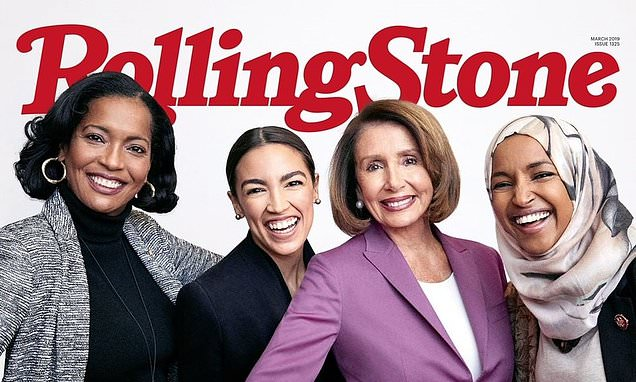
Rep. Ocasio-Cortez and Rep. Pelosi together on the cover of Rolling Stone (March 2019)
We should also say that this problem is deeper than just the case of Rep. Ocasio-Cortez. It is a major problem that various locally-endorsed Congressional candidates are largely blank slates on foreign policy. Where do Claire Valdez (endorsed by NYC-DSA to succeed Rep. Nydia Velázquez), Chris Rabb (endorsed by Philadelphia DSA to succeed Rep. Dwight Evans), and Darializa Avila Chevalier (endorsed by NYC-DSA to run against Rep. Adriano Espaillat) stand on foreign policy? What do they think of NATO’s eastward encroachment, and how do they propose to wind down the war in Ukraine? Do they propose to send more money and weapons into the conflict, like Rep. Ocasio-Cortez has? Would they posture aggressively towards China, or back a system of tariffs in line with the approach promoted by some of the U.S. unions whose endorsements they seek? Nobody really knows, and none of our electoral forums, as far as we can tell, have publicly fleshed any of this out. When NYC-DSA held a forum on the candidacy of Chi Osse, foreign policy was barely discussed. Our failure to kick the tires on Rep. Ocasio-Cortez back in 2018 was perhaps understandable, and sure, the organization is still getting its bearings, but this really reads like a failure to pay attention to some of the most important issues facing the worldwide socialist movement.
A political program that makes these kinds of issues an afterthought is downright destructive. Let’s look at the example of Kat Abughazeleh, a figure who had been promoted within socialist circles to fill the seat being vacated by Rep. Jan Schakowsky. Abughazeleh has a long and sad history of bending “progressive” intentions towards right-wing foreign policy positions. She is a fairly good example of the “compatible left.” Her national security advisor described her as “firmly an interventionist,” saying that Abughazaleh believes “the world is better off when America takes a leading role” and that the U.S. has “an obligation to support pro-democracy movements around the world, from Iran to Venezuela.” He also stated that “Kat wholly supports the National Endowment for Democracy, as well as its affiliated organizations (NDI, IRI, and the AFL-CIO’s Solidarity Center),” and added that Congress should use tools “from sanctions to NGO support” to advance those efforts without necessarily resorting to “kinetic force.” On Ukraine, Abughazeleh would “hold the line” (notice the similarity to Rep. Ocasio-Cortez’s framing), support “funding the Ukrainian war effort to the hilt” (same), back long-range strikes on Russian strategic targets, deploy additional U.S. “air, naval, and ground assets” to NATO’s front line, and “support[] the seizure and redistribution of Russian assets in Europe and the United States, for the purpose of financing the war effort.”
All of this is reflective of the right-wing batshit foreign policy, and it was rightfully condemned within left wing circles. However, these policy positions—stated by Abughazeleh with clarity rather than stammering—also line up almost perfectly with what Rep. Ocasio-Cortez was able to meekly babble at the Munich Security Conference. Whereas Abughazaleh believes “the world is better off when America takes a leading role,” Rep. Ocasio-Cortez had cautioned against the United States “retreating” from the world stage. Whereas Abughazaleh believes the U.S. has “an obligation to support pro-democracy movements around the world, from Iran to Venezuela,” Rep. Ocasio-Cortez critiqued Trump for leaving the “Maduro regime” intact and viciously critiqued Iran just weeks before the bombing campaign began. Whereas Abughazaleh “wholly supports the National Endowment for Democracy,” Rep. Ocasio-Cortez criticizes Trump for playing “hokey-pokey with USAID.” Whereas Abughazaleh plans to “hold the line” and support “funding the Ukrainian war effort to the hilt,” Rep. Ocasio-Cortez similarly highlights her support for Ukrainian military aid packages and insists that she will not “allow” Russia to continue. It really looks like Abughazaleh’s team is saying more directly what Rep. Ocasio-Cortez was only stumbling through. These two candidates are cut from the same ideological cloth. Their arrival at the national stage is not a coincidence, either, but is instead a major warning about the Democratic party’s ability to jiu-jitsu socialism’s momentum into a ditch.
We can’t be suckers. This is all happening right out in the open. Disappointingly, DSA-backed candidates Rashida Tlaib and Ilhan Omar both endorsed Kat Abughazeleh in the final days of her failed campaign. So did Claire Valdez. By endorsing someone with such anti-socialist viewpoints, these DSA elected officials are helping to “manufacture consent” within DSA membership and the broader public regarding right-wing psychotic positions. It’s bad.
We urge everyone reading this (thank you for making it to the end) to vote against re-endorsement, and to uphold the standards that we had set out in R22.
1 It’s worth noting, however, that even as Rep. Ocasio-Cortez was protesting at Rep. Pelosi’s office, she was simultaneously singing her praises. According to the Washington Post on November 13, 2018, Rep. Ocasio-Cortez explained the protests as a form of support: “Should Leader Pelosi become the next speaker of the House, we need to tell her that we’ve got her back in showing and pursuing the most progressive energy agenda that this country has ever seen.” In other words, this was an early example of Rep. Ocasio-Cortez trying to have it both ways, protesting Rep. Pelosi while also arguing that she was protesting to show support for Pelosi. As Ryan Grimm later recounted in his book The Squad, when Drew Hammill (Pelosi’s Chief of Staff) objected to the protest and asserted that Pelosi and Ocasio-Cortez were fighting for the same goals, Rep. Ocasio-Cortez responded: “That’s absolutely true. What this [i.e., the protest] just needs to do is create a momentum and an energy” to pursue those common climate goals.
2 In June 2022, Rep. Ocasio-Cortez herself endorsed John Fetterman.
3 When Russia underwent massive (although not total) privatization in the 1990s following the collapse of the Soviet Union, Wall Street investors in New York benefitted massively. On March 24, 1995, the Wall Street Journal asked: “Looking for an investment that could gain 2,000 per cent in three years? Only one stock market offers that hope . . . Russia.”
4 In addition to engaging in a pattern of privatizing state owned enterprises, Ukraine has also passed other anti-communist laws in recent years. On May 21, 2015, The Guardian reported that Ukraine had passed extreme anti-Communist legislation, criminalizing even expressions of sympathy to the former Soviet Union, “making something as trivial as selling a USSR souvenir, or singing the Soviet national hymn or the Internationale, punishable by up to five years in prison for an individual and up to 10 years in prison for members of an organisation.” The law also makes it illegal to deny the “criminal character of the communist totalitarian regime” in the media or elsewhere. The Kyiv Post further reported on July 24, 2015 that, based on recent legislation, “[f]rom now on, Ukraine’s communists may not set up their own political party or enjoy any rights stemming from them, including the right to participate in the electoral process.” A broader discussion of this explicit campaign of “decommunization,” and its relationship to far-right politics, is, however, beyond the scope of this analysis. The point here is that Ukraine has been ruled by a far-right extremist government ever since the violent 2014 coup.
5 Although there is little reporting on the economic philosophies of the different factions, and their outlook on Ukraine’s campaign of privatization, it’s notable that, on October 4, 2014, the New York Times reported that “[i]n the Donetsk region of eastern Ukraine, the Supreme Soviet, as its separatist legislature is known, is nationalizing coal mines and reviving collective farms.”