21CS Guide to the Attacks Against Venezuela

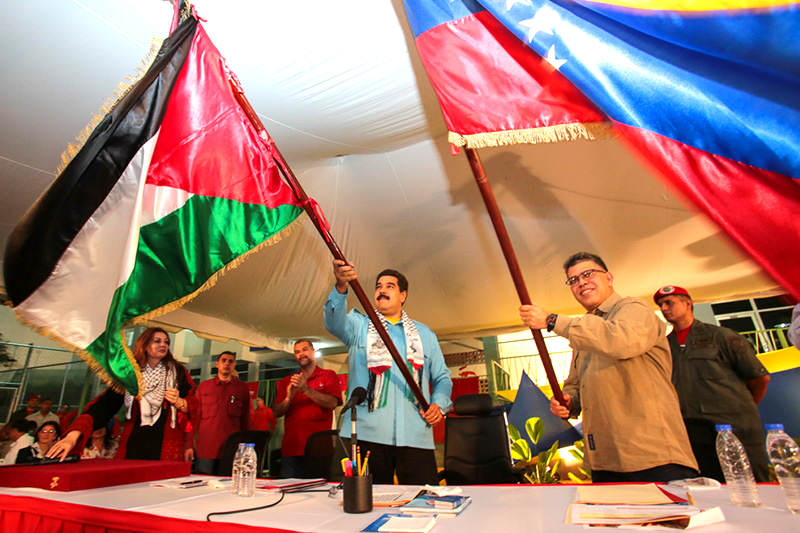
President Maduro at an event inviting Palestinian youth to train in engineering and other sciences in Venezuela. Credit: VTV
On January 3, 2026, the United States military invaded Venezuela, murdered more than one hundred people, and kidnapped both President Nicolás Maduro and First Lady Cilia Flores. The President and First Lady are being illegally detained in Brooklyn right now, where the Trump administration seeks to pursue an unjust trial in an American courtroom that has no jurisdiction. This analysis will review why this kidnapping took place, what the political landscape looks like right now, and how we can move forward. Above all, this analysis seeks to provide guidance to DSA members and elected officials so that we can not just understand current events, but change them.
A Short History of the USA’s Attempted Coups and Illegal Sanctions
The United States has sought to topple the Venezuelan government ever since President Hugo Chávez was first democratically elected in December 1998. President Chávez was one of the best anti-imperialist socialists of our lifetime, effectively wresting control over Venezuela from the United States and using the country’s natural resources to build an inspiring and popular socialist project. He got results. He provided material change for the working class, rather than just rhetoric. Importantly, he—together with the broader Chavista movement—physically defended his country’s socialist project against violent aggression from the United States, particularly during a right-wing coup that President George W. Bush had orchestrated.
President Hugo Chávez is still remembered today by the left as a hero of the worldwide socialist project, particularly because of his ability to speak clearly about United States imperialism. Among his more iconic moments, he delivered a speech in 2006 to the United Nations where he said that the podium still carried the stink of sulphur from President George W. Bush’s presence there earlier. The details of that speech, however, are still very relevant today. President Chávez correctly identified that President Bush (“the spokesperson for imperialism”) was seeking to impose the United States model of exploitation and plundering on Venezuela, and that all of President Bush’s bluster about “peace” and “democracy” was a false smokescreen. President Chávez walked through the examples of Palestine, Lebanon, Iraq, and Latin America to deliver a very clear explanation and cut through the bullshit.
In the nearly twenty years since that speech, the United States has gone out of its way to demonstrate—right before our eyes—exactly how correct President Hugo Chávez was. During the George W. Bush years (2001-08), in addition to backing a failed right-wing coup against President Chávez, attempting to “lynch” government officials (2002), and backing an oil industry capital strike (2003), the United States supported violent attacks in Caracas (2004) and officially labeled Venezuela as “non-cooperative” in the so-called war against terrorism (2005) in order to block the sales of certain industrial equipment to the country. All along the way, the United States funneled money towards right-wing extremists like María Corina Machado (who comes from an extremely wealthy right-wing family and was involved in the coup against Chávez), and engaged in extensive propaganda campaigns through the so-called National Endowment for Democracy (NED). Leaked communications from the United States openly acknowledged that the strategy had been about “dividing Chavismo” and “isolating Chávez internationally.” When street fighting broke out (guarimbas), leaked cables described the rioters as “our grantees” (i.e., recipients of NED funding). None of this worked, however, as Venezuela’s GDP continued to grow (notwithstanding the harmful shock of the oil strike), poverty levels were halved (2002-12), and President Chávez’s popularity made him virtually untouchable. When the right wing of the country tried to push a recall referendum against President Chávez, he called their bluff and simply moved forward with their proposal and won with approximately 60% of the vote (even the Carter Center was forced to admit that the results fairly “reflect the will of the Venezuelan electorate”).
During President Barack Obama’s presidency (2009-16), the aggression only escalated. Although there was less activity during President Obama’s first term (when the popular Hugo Chávez was very difficult to undermine), the Obama administration slammed on the gas pedal shortly after President Chávez’s death in March 2013. It started with the State Department and NED budgeting millions of dollars to support a propaganda campaign in Venezuela, according to an investigation by the Associated Press (following a long-standing pattern of United States funding for anti-Chávez political parties and non-governmental entities). The goal was to win the race to succeed President Chávez, defeat then-Vice President Maduro, and install a puppet through a bit of deceit. Despite all this money and effort, however, Nicolás Maduro beat far-right candidate Henrique Capriles (who was aware of the unpopularity of far-right politics, and tried with the United States’ help to run a misleading campaign using pseudo-socialist language). Once again, despite yet another propaganda campaign to undermine the electoral results, the Carter Center (following former President Jimmy Carter’s statement that “the election process in Venezuela is the best in the world”) called for recognition of President Maduro’s victory following the National Electoral Council’s (CNE) certification of the results.
Having repeatedly failed in their propaganda efforts to oust the socialists from power, the right wing erupted with a fit of violent street protests in 2014. To be clear, this attempt to falsely dispute election results and then resort to violence was an early precursor to President Donald Trump’s January 6, 2021 attempt, and Jair Bolsonaro’s January 8, 2023 attempt (except that it was far more violent). It was a serious effort at a right-wing coup d’etat, with decapitations and the burning down of universities. The right wing used guns and Molotov cocktails, attacking government buildings, television stations, and civilians. President Maduro noted that “these are trained groups who . . . are prepared to overthrow the government in a violent way, and I’m not going to allow this, so I call on Venezuela to be peaceful.” The police, along with the supportive Chavista community, responded to stop the violence proportionally, and the Attorney General proceeded with prosecutions in dozens of cases. Notably, right-wing extremist María Corina Machado (the fake “peace” activist groveling before President Trump today) came out in support of the violent coup attempt, but was only stripped of her post in parliament (the punishment would likely be far more severe if she had been a United States citizen supporting domestic terrorism).
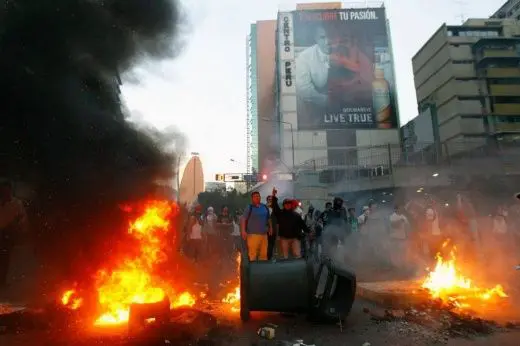
Right-wing protests in Caracas. Credit: Reuters
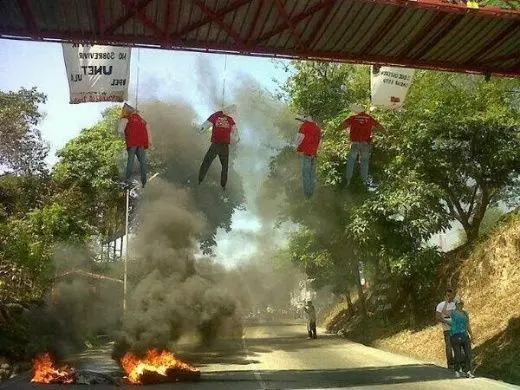
Chavista effigies hung by right-wing rioters. Credit: teleSur
Once again, the right wing failed. This was a very good thing that should have been celebrated across the world. However, rather than celebrating the democratically elected government’s ability to put down these violent right-wing coup attempts, the Western press found the hook that it had long been seeking: they would argue that the government was “authoritarian” and suppressing “political dissent” (without mentioning that the “political dissent” took the form of violent right-wing street fighting led by the upper classes). At times, this has taken on comical dimensions; when Juan David Poletti Pérez was prosecuted for the literal killing of Venezuelan National Guard captain Ramzor Bracho, the BBC reflexively labeled him as a “political prisoner.” This propaganda technique of portraying self-defense as “authoritarianism,” and right-wing violence as “political dissent,” is really the crux of the issue, where the annoying liberal sentiments of President Obama became the propaganda weapon that still infects weak minds today.
Having secured a pretext of opposing so-called “authoritarianism” (using the old anti-communist “left’s” dusty playbook), the United States shifted gears to immiserate the country through sanctions. In December 2014, President Obama signed anti-Venezuela legislation (sponsored by anticommunist Sen. Menendez who is now serving an eleven-year prison sentence himself for corruption) expanding the sanctions system, followed by the U.S. State Department imposing visa restrictions on various officials in February 2015, and a March 2015 executive order bizarrely declaring that Venezuela was an “extraordinary threat to the national security and foreign policy of the United States.” Nobody with a brain seriously thought that Venezuela was a “threat” to the United States, but President Obama was free to lie without serious opposition (an early precursor to President Trump’s fake claims of “narco-terrorism” today). The goal was not to make a serious argument, but rather to make Venezuela toxic to international businesses and to choke the economy.
Within the United States, the actions of President Obama caused the entire liberal class (with some echoes still annoyingly reverberating through small minds in DSA spaces) to view Venezuela as an “authoritarian” entity. Democrats and Republicans teamed up to portray this as the “bipartisan” consensus. House Democratic Leader Nancy Pelosi issued opening remarks for a NED event giving a so-called “democracy award” to Venezuela’s right-wing rioters. Nobody bothered to contextualize the country’s actions within the real-world framework of an undemocratic and violent right-wing coup. With extensive media consolidation, and a total lack of public pushback, the narrative stuck. The actions of President Obama gave all of this nonsense a veneer of academic liberal legitimacy, and effectively adopted the right-wing batshit position as the official consensus among American politicians.
It didn’t take long for President Obama’s actions to have a real world impact. By 2016, Citibank had decided that it was too risky to do any business with Venezuela, and closed its accounts; various other financial institutions and businesses followed suit. The cost of borrowing increased precipitously, because the risk management departments of financial institutions thought it wasn’t worth the risk of running afoul of the always-increasing sanctions. Venezuela was in the process of being cut off from international financial relations that are basic to any country’s survival. Between the sanctions, the street violence, and the oil price crash, the country’s GDP declined by 24.7% between 2013 and 2016.
When President Trump was selected by the electoral college in 2016 (despite having lost the popular vote), the groundwork had already been laid. With the Obama-era propaganda fully saturating the media, Trump entered the White House with a cabinet filled with some of the world’s worst right-wing ghouls (John Bolton, DSA-hater Elliott Abrams, etc.). The conditions were perfect for the right wing anticommunists of the United States to simply carry Obama’s work forward.
During his first term (2016-20), Trump imposed a “maximum pressure” campaign against Venezuela. This included the issuance of various executive orders in November 2018 (EO 1350), January 2019 (EO 13857 and GL8), August 2019 (EO 13884), and April 2020 (GL8F). Rather than explain the details of these actions, one can look simply at a March 2019 explanation from one senior Trump administration official: “The effect of the sanctions is continuing and cumulative. It's sort of like in Star Wars when Darth Vader constricts somebody's throat, that's what we are doing to the regime economically.” The United States also supported an attempt to murder President Maduro using drones in August 2018, and a failed attempt to install a U.S. puppet (Juan Guaidó) in April 2019. Using the legal fiction of the new “president,” the United States effectively stole control of the multi-billion-dollar Citgo company (a fascinating and also somewhat long story). And in another precursor to current events, on August 14, 2020, the U.S. Justice Department bragged about its “largest-ever” seizure of four oil tankers worth of fuel, preventing Iran from trading oil with Venezuela.
Another way to evaluate United States policy is to look at its impacts. On April 25, 2019, the Center for Economic and Policy Research (CEPR) issued a report from economists Mark Weisbrot and Jeffrey Sachs finding that “economic sanctions implemented by the Trump administration since August 2017 have caused tens of thousands of deaths and are rapidly worsening the humanitarian crisis.” Specifically, the report found “more than 40,000 deaths from 2017 to 2018” that were attributable to the sanctions. In short, the sanctions—not to mention the direct attacks—have been absolutely murderous. And, as the Washington Post reported, the Department of Homeland Security had repeatedly highlighted how these cumulative actions “were going to grind the Venezuelan economy into dust and have huge human consequences, one of which would be out-migration.”
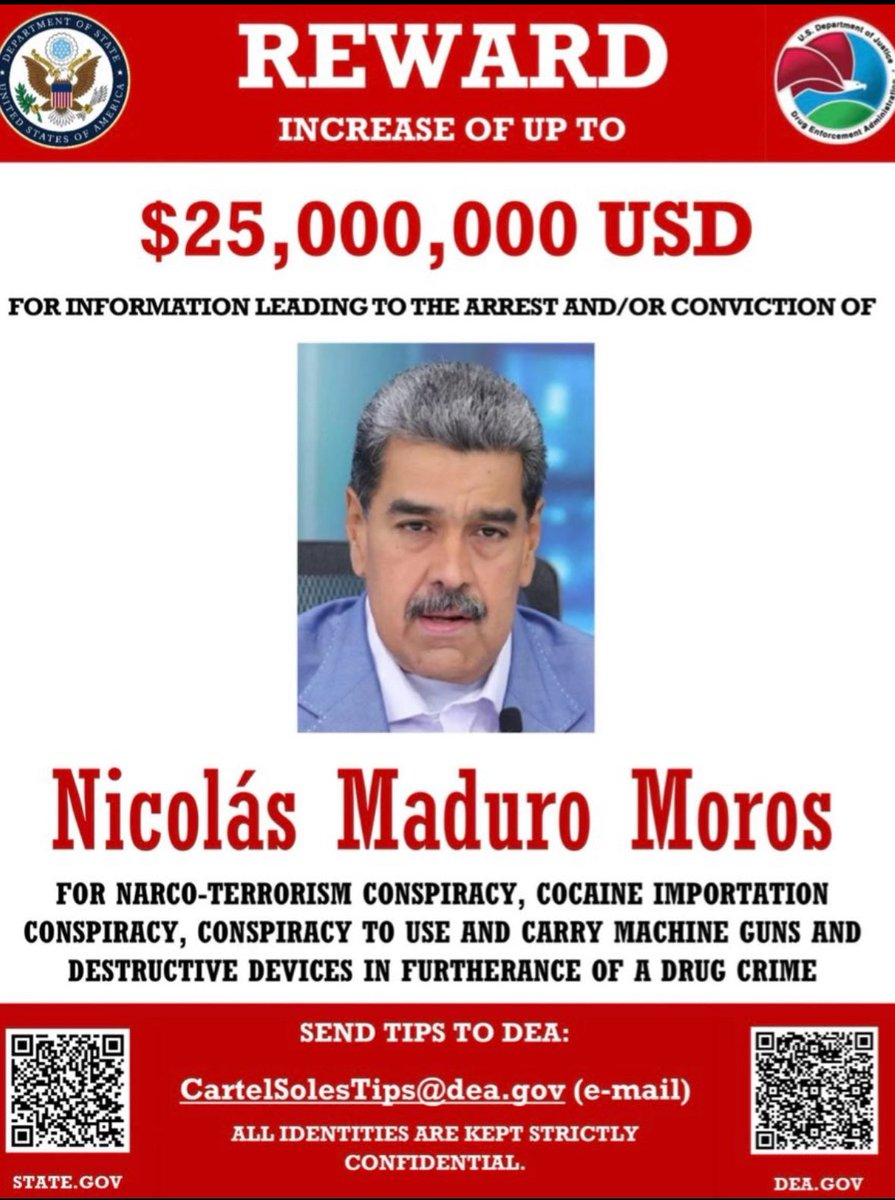
During the short-lived and utterly disgraced Biden administration (2020-24), our geriatric president and the Democratic Congress only increased the pressure on Venezuela. For instance, on September 15, 2022—before he was tried and convicted of corruption himself—Sen. Menendez (D-NJ) held an absurd Congressional hearing where he communicated his own warped anti-Venezuela viewpoint. On November 18, 2024, Congressmen from both political parties made their floor speeches about how much they hated the Venezuelan leadership. The propaganda was incessant, and reached its hysterical heights when President Maduro was democratically re-elected in 2024. Rather than accept these results (which were certified not just by the electoral commission but also by the Supreme Court), the propaganda campaign kicked into hyperdrive. President Biden (or whoever was directing his actions while his cognitive abilities declined) used his final days to impose a bounty on President Maduro of $25 million. In other words, President Biden pre-approved the kidnapping of President Maduro.
Unfortunately, all of this very significant history disappears before the eyes of the Democratic Party and, unfortunately, is not even known by a good portion of DSA members. In fact, it is actively erased. Instead of acknowledging this history, and putting matters into their proper context, you will see various conclusory statements (discussed in further detail below) by the Democrats describing Venezuela’s efforts to defend itself as “authoritarian.” Or, perhaps, you will see some muddle-headed armchair leftists entering DSA spaces to argue that there is some better “third way” that might somehow come to pass if we just echo the Democratic Party’s talking points against “authoritarianism,” and chatter about some distant utopia that’s totally disconnected from the real world.
The Motivation Behind the Latest Attacks on Venezuela
The motivation is admitted openly on television and in the newspapers. In brief, the three goals are to: (i) control the country’s oil supply; (ii) deny any kind of socialist government the ability to function; and (iii) assert general dominance in the Western Hemisphere to the exclusion of perceived “enemies” like China and Cuba.
First, this is about Venezuela’s oil. We won’t dwell on this point because it is obvious. During his first term, President Trump foreshadowed this, saying that Venezuela is “the country we should be going to war with, they have all that oil and they're right on our back door.” Trump also stated at a 2023 Republican Party event that the United States had been ready to move into Venezuela and take “all that oil” by the end of his first term (implying that he’d finish the job if re-elected). In early 2026, following the murderous attacks that killed more than one hundred people, Trump stated that “our very large United States oil companies, the biggest anywhere in the world” would be entering Venezuela to “start making money.”
In explaining his motivation, Trump has complained about President Chávez’s nationalization of the oil industry decades earlier, stating (in revanchist language) that “we want it back.” He has been very direct, declaring his intention “to be taking oil.” In fact, he has been so open that it even makes the Wall Street Journal editorial board nervous: “Mr. Trump also talked about ‘the oil’ far too much, which sends a message that the U.S. purpose is largely mercenary.” Of course, the editorial board doesn’t exactly dispute this motivation, but rather argues that it’s bad form to make this admission so publicly.
Beyond the rhetoric, the Trump administration’s actions make the oil focus perfectly clear. Even before the latest attack and kidnapping, the Trump administration had engaged in acts of international piracy, seizing oil tankers that had been carrying Venezuelan oil. As of this writing, the Trump administration has illegally seized at least seven oil tankers (Bella 1, Galileo, M Sophia, MV Sagitta, Olina, Skipper, and Veronica) during his second term. Trump has stated that the “Oil will be sold at its Market Price, and that money will be controlled by me, as President of the United States of America.” On January 14, 2026, the Trump administration announced that it had begun selling the oil that it had stolen from Venezuela, and that the “majority” of the stolen oil would need to be sold to United States companies. The Financial Times also reported on January 15, 2026 that $250 million of the stolen oil was sold to Donald Trump’s “megadonor” John Addison and his company Vitol; Reuters similarly reported on January 15, 2026 that Trafigura would be purchasing oil that had been sold at a discount as compared to comparable oil on the world market. Another portion, as reported by Bloomberg on February 10, 2026, would be sold to Israel’s largest refinery (Bazan Group), marking the “first crude oil cargo to Israel in years” now that the United States and its intermediaries are dictating the oil sales. In other words, oil is being stolen from Venezuela and given to Israel.
The entire mechanism by which the United States deals with the stolen oil is disgusting. As the Financial Times wrote on January 29, 2026 following Congressional testimony from Marco Rubio, the United States is essentially selling the stolen oil to its favored donors at a discount, keeping a portion of the stolen oil proceeds for itself, and only allowing a portion of the sales proceeds to go back to Venezuela if the sovereign country submits a “budget” to the United States regarding how it will spend the money. The goal is to ensure that any portion of the stolen money that is given back to Venezuela will only be released if it is spent for the purchase of goods sold by the United States.
Second, this is about the destruction of any kind of socialist example in the world. Donald Trump stated in February 2019 that “the twilight hour of socialism has arrived in our hemisphere, and, frankly, in many, many places around the world.” According to Trump, “the days of socialism and communism are numbered not only in Venezuela, but in Nicaragua and in Cuba as well.” The diminutive Marco Rubio—a man that Sen. Bernie Sanders bizarrely voted to confirm as Secretary of State—has long argued that there can be no diplomacy with socialist countries because “if you compromise with socialists, you end up with socialism.” Anyone with eyes and ears understands that the prime directive for the right wing in the United States is to exterminate socialism and communism internationally. Even the Wall Street Journal editorial board dismisses Marco Rubio’s description of this as a “law enforcement” action, calling this a “dodge to avoid saying this is about regime change” (the term they use is “regime change” because they love to call Venezuela a “regime” instead of a democracy)
Finally, the third motivation (closely related to the second one) is to generally control the Western hemisphere and deny access to perceived “enemies” like China and Cuba. Again, this is all stated openly in a November 2025 National Security Strategy document:
The United States must be preeminent in the Western Hemisphere as a condition of our security and prosperity—a condition that allows us to assert ourselves confidently where and when we need to in the region. The terms of our alliances, and the terms upon which we provide any kind of aid, must be contingent on winding down adversarial outside influence—from control of military installations, ports, and key infrastructure to the purchase of strategic assets broadly defined.
The document repeats the goal that “we want a Hemisphere that remains free of hostile foreign incursion or ownership of key assets,” and that it will be United States policy “to ensure our continued access to key strategic locations” and “enforce a ‘Trump Corollary’ to the Monroe Doctrine.” Other countries will need to face a “choice” as to “whether they want to live in an American-led world” or in one that is “influenced by countries on the other side of the world” (i.e., China). And, to be perfectly clear, when the administration says that it wants to rid the Western hemisphere of “hostile” entities, they mean Cuba and China. The editorial board of the Wall Street Journal calls the aggression against Venezuela an act of “hemispheric hygiene.” They want to “cleanse” the hemisphere of any traces of socialism, or even any kind of defiance that stands in the way of United States capitalism and imperialism.
It’s no secret that Donald Trump has been obsessed with China, and trying to restrict the powerful country from the Western hemisphere. In his first trip abroad as secretary of state, Marco Rubio went to Panama, where he bullied the country to withdraw from China’s Belt and Road Initiative (BRI). Donald Trump also interfered in the Honduran election to install right-wing candidate Nasry Asfura, because Asfura had promised to break diplomatic ties with China. The latest actions in Venezuela—which were quickly coupled with efforts at “pressuring the interim Venezuelan government to expel official advisers from China”—were clearly designed to cause indirect harm to China by viciously attacking one of its trading partners. After Trump was humiliated by his failed attempts to bully China over tariffs (which this caucus wrote about in more detail here), the pivot back to the Western hemisphere is perhaps best seen as a sort of strategic retreat.
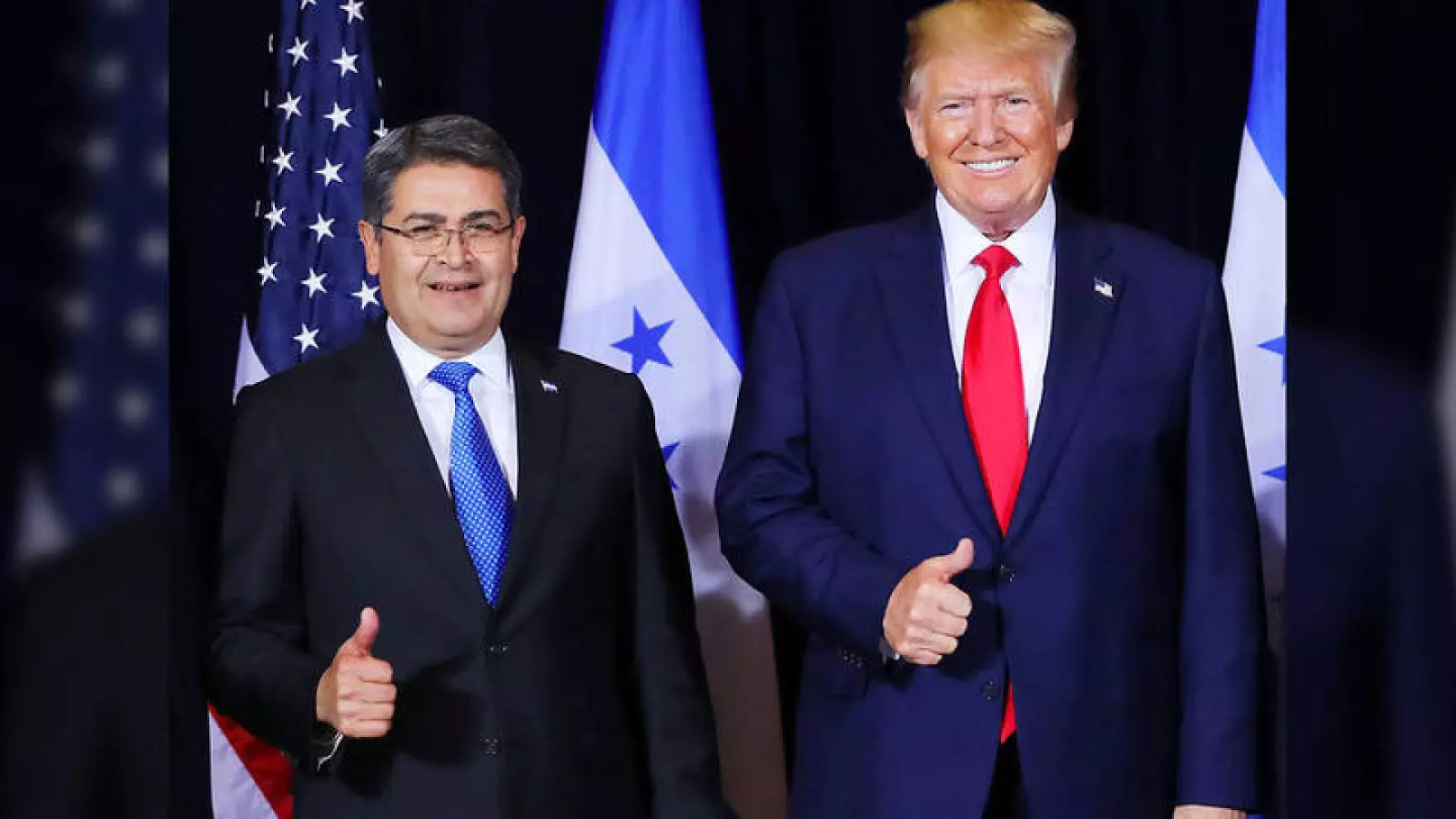
President Trump with now-pardoned former Honduran president Juan Orlando Hernandez who was prosecuted in 2024 for smuggling over 400 tons of cocaine.
In addition to attacking China, this is clearly about attacking (and attempting to destroy) Cuba. Again, this is very clear with Trump saying the following on social media:
Cuba lived, for many years, on large amounts of OIL and MONEY from Venezuela. In return, Cuba provided ‘Security Services’ for the last two Venezuelan dictators. BUT NOT ANYMORE! Most of those Cubans area DEAD from last wees U.S.A. attack . . . . THERE WILL BE NO MORE OIL OR MONEY GOING TO CUBA - ZERO! I strongly suggest they make a deal, BEFORE IT IS TOO LATE.
On January 27, 2026, Trump was even more blunt, saying that “Cuba will be failing pretty soon,” and issuing a new executive order on January 29, 2026 to increase the sanctions. With Mexico now restricting oil shipments due to their own threats, the pressure on Cuba is increasing.
This is fully in line with the childhood ambitions of tiny Marco Rubio, who whined in his 2012 book that he has long dreamt about putting on a little uniform and invading Cuba to overthrow its communist government (something that he never had the physical courage to do in reality). He built his entire political identity around being a “son of exiles” even though his family had fled under the right-wing terror of Batista’s actual dictatorship in Cuba (which Fidel Castro had the actual physical courage to depose). For him, overthrowing Venezuela is not just a good thing in and of itself, but also an indirect way to achieve his broader ambition of having taller people violently overthrow Cuba on his behalf. This is a simple case of social murder by small sociopaths.
Of course, this is about more than just China and Cuba. The Trump administration has already intervened in Argentina and Honduras to push for right-wing governments. There will be important elections coming up in 2026 in both Colombia (May) and Brazil (October). We have already seen explicit threats from the Trump administration against Colombia (saying that President Petro needs to “watch his ass”) and Mexico (saying that “we are going to start now hitting land” targets inside Mexico with the U.S. military), and it’s no coincidence that these threats are concentrated against left-wing governments that aren’t simply junior partners in American imperialism.
In short, the United States wants to exterminate any traces of socialism or communism from the Western hemisphere, and remove any obstacles to its exploitative ambitions. It’s very important that we stand collectively against this broader project.
What the Right-Wing Extremists Want
Just as much as the United States wants to exploit the Western hemisphere, there are also certain elements within Venezuelan society who desperately want to become junior partners in the United States’ exploitation of their country. They want a return to the miserable status quo of imperialism from before President Chávez, when their comprador class ruled the country. They would gladly sell their brothers and sisters to imperialism. This is what is called “vendepatria.”
María Corina Machado is exactly this type of elitist sell-out. Her career began in 2002, when she created an organization called “Súmate” and quickly found that she could secure tremendous amounts of cash from the United States (through NED) if she used the organization to tell the United States what it wanted to hear. Over the years, Machado has used Súmate to try to de-legitimize every expression of popular support for Presidents Chávez and Maduro by making fake claims of “fraud” in every single election cycle (no matter how many international organizations disagreed with her). In addition to supporting previous coup attempts against Presidents Chávez and Maduro, Machado has been crystal-clear regarding her own ambitions to become the next Juan Guaidó, and she is completely unashamed in her butt-kissing attempts to ingratiate herself to Donald Trump. Her supplication and humiliation has reached embarrassing lows, with the cringe-worthy example of gifting her unearned Nobel “peace” prize to Donald Trump in order to thank him for bombing her country. (Interestingly, this echoes the example from Knut Hamsun who similarly gifted his Nobel Prize to Nazi propaganda minister Joseph Goebbels in order to try to gain favor with Adolf Hitler.)
The history of Machado’s political statements is worth dwelling on for a moment. In order to try to attract favor from the United States, Machado has a long history of repeatedly and publicly promising to sell out Venezuela to American capitalism. President Chávez has had total disdain for Machado over the years, and she has been unable to develop a serious following (91% of Venezuelans hold an unfavorable view of Machado), but the Western press has never grown tired of attempting to elevate her (reaching comical heights when she was given the Nobel “peace” prize). In 2017, when Trump imposed illegal and murderous sanctions on Venezuela, Machado praised him on social media. In 2018, she tried to instigate military intervention, demanding “international force” because the sitting government “will only leave through force.” In June 2023, she declared her desire “to privatise and open up the markets, beginning with the energy sector.” As for the country’s oil, gas, and minerals, Machado promises that if she were put in charge they “will all be open to private investment.” In an interview with Donald Trump, Jr. in February 2025, she went even further:
Forget about Saudi Arabia, forget about the Saudis. I mean, we have more oil, I mean, infinite potential. And we’re going to open markets. We’re going to kick [out] the government from the oil sector. We’re going to privatize all our industry. Venezuela has huge resources: oil, gas, minerals, land, technology. And, as you said before, we have a strategic location, you know, hours from the United States. So we’re going to do this right. We know what we have to do. And American companies are in, you know, a super strategic position to invest. This country, Venezuela, is going to be the brightest opportunity for investment of American companies, of good people that are going to make a lot of money.
It’s clear as day that the right-wing in Venezuela wants to promise “American companies” that they will make “a lot of money” if only they choose Machado or another right-wing puppet. They are trying to sell this as a win-win to the United States, even though these upper-class twits remain quite unpopular and divided.
In a rare moment of clarity, Donald Trump has acknowledged that Machado “doesn’t have the support within or the respect within the country” in order to assume leadership. This is correct.
What Happens Next
What happens next is still unclear. Donald Trump is still seizing oil tankers, and intends to proceed with a show trial of President Nicolás Maduro in New York City. However, he does not yet control Venezuela, and foresaw that a broader ground invasion would not have been successful. He also foresaw that installing a butt-kissing puppet like Machado would not exactly work.
Even though Trump does not control Venezuela, he is still effectively holding a gun to the head of its leadership, and is attempting to use the stolen oil as a tool to manipulate various actors into compliance. The “gun to the head” language is not even metaphorical; in recounting the Trump administration’s murderous attack, acting president Delcy Rodríguez said:
The threats began from the very first minute they kidnapped the president. They gave Diosdado [Cabello, the interior minister], Jorge [Rodríguez, the acting president's brother and congressional president,] and me 15 minutes to respond, or they would kill us.
From then on, “the threats and the blackmail are constant,” with leadership already being forced to make changes to the country’s hydrocarbon laws. Nevertheless, the acting president says that “we have to proceed with patience and strategic prudence, with very clear objectives, brothers and sisters,” aimed at the pursuit of three goals: “to preserve peace ... to rescue our hostages ... and to preserve political power.” The ability of acting president Delcy Rodríguez to manage the crisis will be an ongoing struggle inside Venezuela, because the pressure from the United States has evolved and increased.
The ability of the international community to respond to this crisis is another open question. Unfortunately, the “international community” seems to be more concerned with a hypothetical attack against Greenland than with the very real attack against Venezuela. There has been some support from the United Nations, China, Russia, Cuba, Mexico, Colombia, Brazil, and elsewhere. However, the international response to this has so far been quite weak (with Lula in Brazil being especially weak). The same “international community” that failed to stop the genocide in Gaza does not seem like it is going to be able to do much about this kidnapping and murder.
Within the labor movement, there has likewise been no significant support that we have seen. At best, the AFL-CIO has given a confused response. First issuing a condemnation of the attack on January 3rd but then later pushing to get a cut of the profits of imperialism, writing an open letter “calling on the Trump Administration and Congress to require that any crude oil imported from Venezuela be transported exclusively on U.S.-flag vessels crewed by American mariners.” This is obviously gross opportunism.
Within the media, the propaganda campaign has been intense. Just days after the violent attack, the New York Times published an op-ed titled “Trump Was Right to Oust Maduro” (1/5/26). Following that, they enlisted right-wing ghoul Elliot Abrams to write a piece titled “The Case for Real Regime Change in Venezuela” (1/7/26), and an extensive interview with him titled “A Defense of U.S. Intervention in Venezuela” (1/7/26). As for the future of Venezuela, the New York Times published a bizarro guest essay objecting to Trump’s sidelining of far-right extremist Machado, falsely calling her “by far, the country’s most popular politician” (1/8/26). In short, the liberal press is trying to ensure that a right-wing comprador succeeds in deposing the socialists. This isn’t opposition, so much as encouragement to go further.
Within Congress, some Democrats have wrung their hands and objected merely to the fact that Donald Trump didn’t get a Congressional permission slip before launching his invasion. There have been a few attempts to pass a war powers resolution, disapproving of the attacks against Venezuela, but so far Donald Trump has been able to make sure that the Republicans stay in line. Every time that one of these votes fails, it drives home the point that although Congress didn’t pre-approve of the invasion, it also doesn’t quite disapprove of it either. The effectiveness of this particular tactic is one that we should carefully examine, especially as Democrats have been using their time on the floor to ritualistically condemn President Maduro in between their failed votes. It’s also worth noting that Democratic leader Sen. Schumer had, for years, criticized Trump insofar as “he hasn’t brought an end to the Maduro regime.” Following the latest invasion, Schumer was even critical of Trump for not going further insofar as he left Delcy Rodríguez in charge (Schumer calls the acting government “people who hate America”). In recent days, he also personally hosted Machado in Washington D.C., to say that he “admires” her and that he wishes all Americans would support her. In short, much like the New York Times propaganda, Schumer wants the right-wing comprador class to re-take power.
Given the failings of the labor movement, the international community, the media, and the Democrats, it’s especially important that we all step up from within the belly of the beast. Within the United States, the court case against President Nicolás Maduro presents a unique organizing opportunity. This trial is an absolute sham, and it is taking place right in the city where DSA’s presence is the largest, and where a DSA-backed elected official is currently the Mayor. We have the opportunity to clearly build a consensus regarding the illegitimacy of this trial, and against the authoritarian Trump regime. To be clear, the indictment does not contain allegations that President Maduro is “authoritarian” or that he “stole elections.” Rather, the indictment is limited to vague and discredited allegations of “narco terrorism” (whatever that means) and is very vulnerable. Anyone can see that this show trial is deeply illegal, and there is an opportunity to organize on the ground to completely delegitimize it.
The Propaganda Push
Clarity regarding the illegality and illegitimacy of these actions is crucial because there is a very heavy-handed mechanism for pushing propaganda against Venezuela. Both of the major political parties push a narrative designed to delegitimize Venezuela, and all of the major news outlets do as well. There is a well-oiled machine that exists to squash any expressions in favor of Venezuela and President Maduro before they even take form. This is perhaps best illustrated by Jorge Ramos’s embarrassing cross-examination of Zohran Mamdani on September 17, 2025.
Ramos: Politically, I think I have to ask you this question, just going back to socialismo, do you think that Miguel Díaz-Canel in Cuba is a dictator?
Mamdani: I haven't thought much about Miguel Díaz [sic], I'll be honest with you. I think mostly about these five boroughs and how we can actually deliver affordability for New Yorkers.
Ramos: But do you think Nicolas Maduro is a dictator in Venezuela?
Mamdani: I think he has done many a horrible thing.
Ramos: But again, do you, do you think it's important that you say that they are dictators and that people understand here in New York that you are not aligned with them?
Mamdani: I think it's clear and it's important for me to showcase how this is a vision for the people of the city, and as you said, it is in stark contrast to the experiences that many others have had. And I think when I hear from a number of Venezuelan New Yorkers about what drove them to come to this city, the conditions that they had to live through. I understand their skepticism, I understand their caution, and yet I have found in them an understanding that my vision is one that is distinct from that experience.
Ramos: But I wonder if you're reluctant to call them dictators in Cuba and Venezuela.
Mamdani: I'm not reluctant. I just haven't thought about them that often. I'll be honest with you. I think that Maduro's government is one of repression. There's no question about it.
Ramos: And also in Cuba, since 1959.
Mamdani: And I think that the repression that, whether we're speaking about Cuban New Yorkers or Venezuela New Yorkers, that they have had to live through is a repression that stands in a clear contrast from what our vision is here.
This entire exchange is absolutely embarrassing. Watching the video and reading through the transcript, you can clearly see that Zohran Mamdani didn’t know much about Cuba or Venezuela, and initially tried to avoid the issue. He tried to say twice that “I haven't thought much about” the topic, even stumbling over the Cuban president’s name. Nevertheless, Mamdani got absolutely bullied by Jorge Ramos (who is not a journalist so much as an anticommunist extremist) into saying exactly what Ramos wanted him to say. You can watch in real time as Ramos literally puts words into Zohran Mamdani’s mouth. Unfortunately, Mamdani was overmatched and underprepared. It is embarrassing to watch.
At this point, the damage has already been done by Mamdani’s foolish comments. Nevertheless, not content to leave things there, Mamdani (no doubt further pushed by Obama-era advisors like Patrick Gaspard and ambitious Fetterman-era comms professionals concerned about image) issued another “clarifying” statement one week later on September 25, 2025: “I want to be clear about my position. I believe both Nicolas Maduro and Miguel Diaz-Canel are dictators. Their administrations have stifled free and fair elections, imprisoned political opponents, and suppressed a free and fair press.” This second statement was absolutely inexcusable. Even though Zohran Mamdani “doesn’t think much about” Cuba or Venezuela, he now is parroting what’s being told to him in a very harmful manner.
Of course, Zohran Mamdani has been surrounded by a chorus of Democrats who are parroting the same line. We have seen terrible post-invasion statements from Kamala Harris (“Maduro is a brutal, illegitimate dictator”), Sen. Chuck Schumer (“Nicolás Maduro is an illegitimate dictator”), Sen. Kirsten Gillibrand (“Nicolás Maduro was a thuggish dictator”), Rep. Hakeem Jeffries (“Nicolás Maduro is a criminal and authoritarian dictator”), Rep. Dan Goldman ("Maduro is a brutal dictator”), Rep. Adriano Espaillat (“I strongly oppose the illegitimate regime of Nicolás Maduro"), Sen. Bernie Sanders (“Maduro was a dictator”), Attorney General Tish James (“Nicolás Maduro was a brutal dictator”), and many others. None of these people have the spine or the intellectual ability to actually defend against the kidnapping of a sitting president. All of these people are contributing to the problem, tripping all over themselves to defame the democratically elected socialist government of Venezuela. This is a sad echo of how the Democratic Party fell all over itself to condemn Palestinians in recent years, rather than standing up for them in the context of an ongoing genocide. The key theme is that they’re happy to make weak statements regarding a Republican administration’s aggression, but they absolutely cannot tolerate any group fighting back (this is deemed to be either “terrorism” or “authoritarianism”).
To his credit, now-Mayor Mamdani did not repeat this same propaganda following the invasion and kidnapping. Perhaps he learned his lesson, perhaps not; it’s difficult to say whether there has been any kind of change or growth here. Likewise, Rep. Rashida Tlaib, Rep. Ocasio-Cortez, and Rep. Ilhan Omar all appear to have withstood the pressure to make these reflexive condemnations. Regardless, it’s undeniable that the pressure is present everywhere.
With propaganda this thick, DSA as an organization must do better to inoculate its elected representatives. In fact, that’s one of the primary motivations of this writing and you should consider intervening with your local elected official to make sure they do better.
DSA Needs to Actively Push Against the Propaganda
DSA as an organization, particularly in its post-2017 years, has generally gotten the issue of Venezuela right. The platform calls for the United States to “end economic sanctions” against Venezuela. The organization had sent a delegation to Venezuela in 2021, hosted a tour of Venezuelan feminists in 2022, sent election observers on two occasions, and issued various statements to clarify the reality on the ground. The organization even has a “DSA Venezuela Solidarity” Working Group that has been able to rapidly respond in real time to the latest attacks against Venezuela. DSA also organized a mass call on Venezuela, with participation from Brooklyn DSA legislators Sen. Jabari Brisport and CM Alexa Aviles.
For the most part, DSA as an organization needs to simply keep up what it has been doing. However, there still remains ideological confusion among a large segment of DSA’s elected officials (who are subjected to the same intense pressure to condemn President Maduro) and among some of the general membership (which is steeped up to its noses in propaganda). A good chunk of this—perhaps even the bulk of it—is due to a simple “pick me” energy that is exuded by ambitious DSA members: some people might naively think that, if only they throw some socialist example under the bus as a “bad” type of socialism, they’ll finally gain a bit more mainstream acceptance from traditional Democrats who recognize them as “good” socialists. This obviously never works, and the more you give in to anti-socialist demands to “condemn” this or that, the more they will demand from you in the future. You can’t buy their respect by just giving them what they demand. It doesn’t work that way.
There are also some members within positions of DSA leadership who are a bit confused on the Venezuela issue. This came to a head when the DSA International Committee (IC) made a simple and appropriate comment to “congratulate Nicolás Maduro on his re-election to the presidency of the Bolivarian Republic of Venezuela.” In a divided vote, the DSA National Political Committee (NPC) voted to take the statement down without explanation. It appears that the organization was motivated by either attacks in the right-wing press (something that will always exist for a socialist organization taking socialist positions) or by confusion regarding the election results (which can and should be resolved through political education).
It is also worth pointing out that DSA’s existence as a so-called “big tent” necessarily creates some space for the type of “socialists” who are reflexively opposed to any kind of actually existing socialist program that manages to get off the ground and fight back against right-wing attacks. This type of “socialist” will happily talk about socialism “in theory,” or maybe talk favorably about a project that had been crushed by the right wing in the past, but will always be critical of the projects that have developed in the real world (including especially the People’s Republic of China, Cuba, the Soviet Union, and Venezuela). Sometimes they are motivated by the liberal perspective that these efforts went “too far” in attempting to control the means of production; sometimes they will have magical ideas about what they would have done themselves that isn’t grounded in reality. Above all, there is a general lack of curiosity regarding the actual facts and circumstances (or perhaps a smug “I just googled it” kind of pretend-confidence). There is typically an ignorance of exactly how the right-wing, with the support of the United States, is applying pressure that needs to be addressed, coupled with a casual “pacifist” viewpoint that is more like a kind of “passive-ism.”
It is our job to talk with each other, to build connections, and to win these internal struggles inside the organization. This is not a minor issue, but is rather an existential threat to the entire worldwide push for socialism. If Donald Trump can literally get away with defaming, killing, and kidnapping socialists in Venezuela, then he can get away with it anywhere else in the world. Don’t think for a second that these same kinds of tactics can’t happen right here in the United States, because they absolutely can. In recent years, we have seen deportation attempts against Mahmoud Khalil, the murder of anti-ICE protesters in broad daylight, and a livestreamed genocide. In times like these, solidarity is important, and those who seek to sell out socialists and anti-imperialists cannot be allowed to control DSA’s path. Chauvinism has no place in our organization. It’s long past time that we put wrongheaded viewpoints on Venezuela in the “dustbin” of DSA’s history, right next to the Zionism of Michael Harrington.
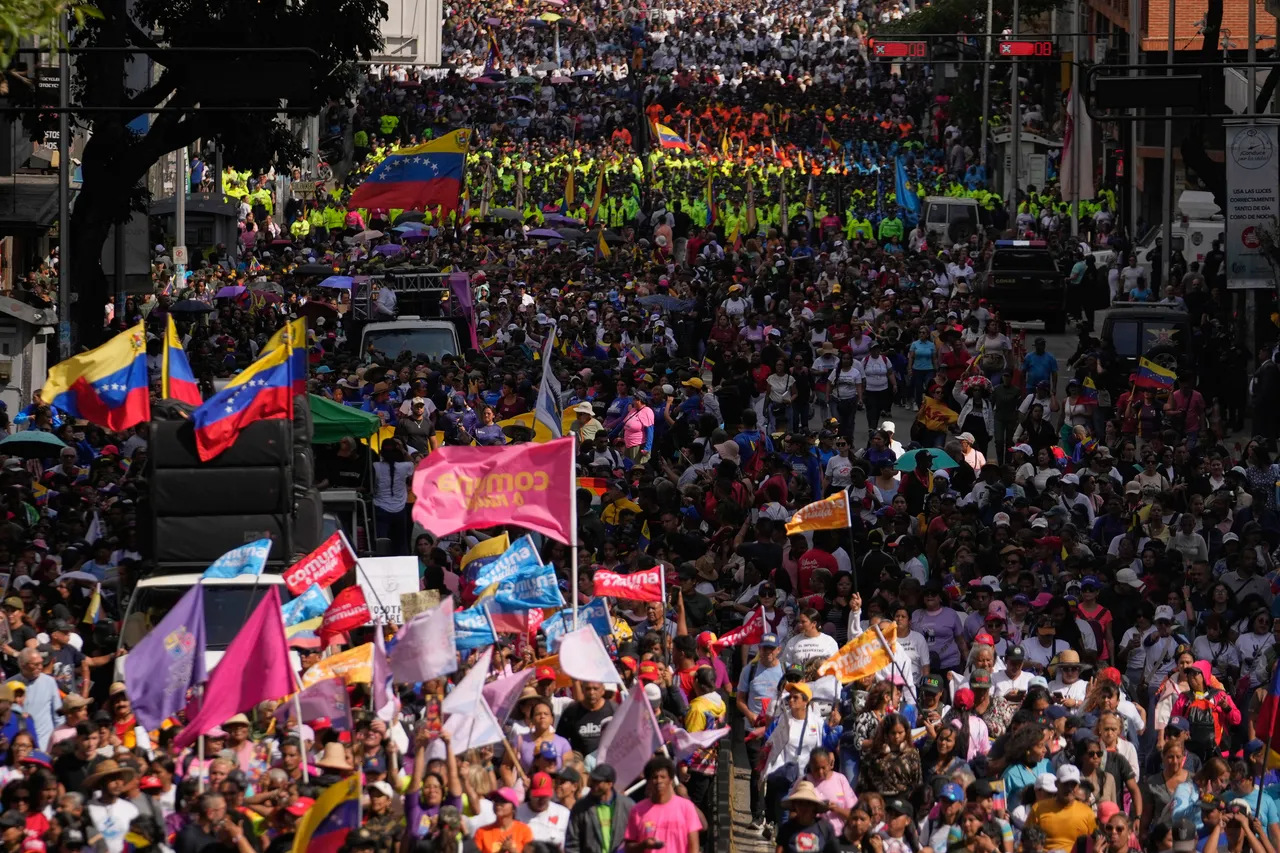
Protests in support of President Maduro, January 6, 2026. Credit: AP